Our Location
304 North Cardinal St.
Dorchester Center, MA 02124

304 North Cardinal St.
Dorchester Center, MA 02124

Drilling for water or geothermal energy through shale formations presents some of the most frustrating and costly challenges in the drilling industry. Many operators notice a sudden, drastic drop in cutting efficiency as soon as the drill bit transitions from sandstones or limestones into clay-rich shale. Understanding why a water drill bit loses its cutting efficiency in shale requires a deep dive into the mechanical, chemical, and physical interactions happening thousands of feet below the surface. Shale is a fine-grained, sedimentary rock composed primarily of compacted mud, silt, and various clay minerals such as illite, smectite, and kaolinite. Unlike brittle formations that fracture easily under the compressive load of a drill bit, shale behaves elastoplastically, meaning it tends to deform, swell, and stick rather than cleanly chip away.
When cutting efficiency plummets, the root cause is rarely a simple case of a dull bit. Instead, it is typically an accumulation of phenomena known as bit balling, thermal degradation, insufficient hydraulic clearing, and structural mismatches between the bit design and the formation physics. Because shale is highly reactive to water-based drilling fluids, the rock absorbs moisture, swells, and transforms into a sticky, putty-like paste. This paste adheres to the cutters and fills the junk slots of the drill bit, preventing the cutters from making direct contact with the fresh rock face. Consequently, the energy transferred from the drilling rig is wasted on remolding and squeezing the trapped clay rather than cutting new rock. This comprehensive analysis will explore the structural mechanics of shale drilling, examine the exact reasons behind efficiency loss, evaluate the leading industry drill bit brands and models engineered to combat these issues, and provide actionable optimization strategies.
The primary culprit behind a sudden loss of cutting efficiency in shale is bit balling. This process occurs when the clay minerals within the shale, particularly sodium-smectite, come into contact with water-based drilling fluids. The water molecules penetrate the interlayer spaces of the clay crystals, causing them to expand rapidly and become highly cohesive. As the cutters shear the rock, the generated heat and mechanical pressure compress these hydrated clay particles into a dense, sticky mass. This sticky clay adheres directly to the face of the cutters and packs tightly into the fluid courses and junk slots of the drill bit.
As the bit balling worsens, the clay builds up to a thickness that exceeds the exposure height of the cutters. At this point, the cutters are completely masked by a cushion of mud. Instead of the sharp diamond or carbide edges penetrating the rock, the blunt, clay-covered body of the bit simply rides on top of the formation. The rate of penetration drops exponentially, and the torque readings on the rig fluctuate wildly as the bit repeatedly sticks and slips against the compressed clay cushion.
Hydraulics play an equally vital role in maintaining cutting efficiency as the mechanical cutting structure itself. In shale formations, if the hydraulic energy at the bit is insufficient, the sheared cuttings cannot be evacuated from the bottom of the hole fast enough. Water drill bits rely on the velocity and volumetric flow rate of the drilling fluid exiting the nozzles to sweep the rock face clean. When drilling through sticky shale, standard flow rates are often inadequate to overcome the adhesive forces binding the clay to the steel or matrix body of the bit.
If the nozzle configuration is poorly optimized—for instance, if the nozzles are focused too far from the cutter faces or if the fluid velocity is too low—stagnant zones form across the bit face. In these stagnant zones, cuttings accumulate and cross-flow occurs, which means fluid bypasses certain cutters entirely. Without targeted hydraulic crossflow to wash the face of every single cutter, the mechanical energy applied to the drill string is absorbed by the accumulated cuttings, resulting in a severe drop in mechanical efficiency and accelerated thermal wear.
Shale requires a specific cutting mechanism to be drilled efficiently. While hard rocks are crushed using the impact force of roller cones, shale is best drilled using the shearing action of Polycrystalline Diamond Compact (PDC) cutters. However, if the cutter geometry is not perfectly matched to the specific characteristics of the shale, efficiency is lost rapidly. One critical geometric factor is the back rake angle, which is the angle at which the cutter face meets the rock.
If a drill bit has a high back rake angle, it behaves aggressively, but it also generates high friction and encourages clay to pack tightly against the cutter face. Conversely, if the back rake angle is too low, the cutter cannot generate enough mechanical peel to lift the ductile shale away from the bottom of the hole. Furthermore, using a bit with too many blades or overly crowded cutters restricts the volume of the junk slots. In shale, large junk slots are mandatory to accommodate the high volume of loose, expanding cuttings. A bit designed for hard limestone with dense cutter placement will choke almost instantly in a soft, sticky shale formation.
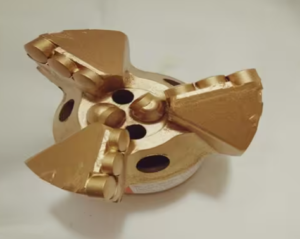
Schlumberger, through its Smith Bits division, is a global leader in designing specialized drill bits capable of overcoming the severe efficiency losses associated with shale formations. Their engineering focus centers on advanced material science and customized hydraulic configurations.
The AxeEdge line features unique, ridge-shaped PDC cutters rather than traditional flat-faced cutters. The ridge design concentrates the mechanical weight on bit across a much smaller surface area, allowing the cutter to slice through ductile shale with significantly less force. This specialized geometry alters how the shale breaks apart, generating smaller, more manageable cuttings that are less likely to stick together and cause bit balling. The underlying engineering minimizes friction, keeping the cutter face cooler and preventing the thermal degradation of the diamond table when passing through interbedded shale sequences.
The Kinetic series represents Schlumberger’s premium line of matrix-body PDC bits, engineered specifically for high-speed, high-vibration environments like directional water well or geothermal drilling through shale. The matrix body is highly resistant to the abrasive silt and quartz particles frequently embedded within shale layers. The Kinetic bits are configured with asymmetrical blade designs and optimized nozzle orientations that maximize fluid velocity across the cutter faces, effectively washing away clay before it can adhere to the tool.
Baker Hughes addresses the problem of shale efficiency loss by focusing on cutter dynamics, depth-of-cut control, and premium diamond technologies that minimize friction and adhesion.
The Talon bit platform is specifically engineered to deliver high rates of penetration in interbedded and clay-rich formations. These bits utilize an application-specific cutter layout combined with polished cutter technology. By polishing the diamond face to a mirror-like finish, Baker Hughes radically reduces the coefficient of friction between the cutter and the shale. The smooth surface prevents the sticky clay particles from finding a mechanical anchor point on the cutter, allowing the hydraulic flow to easily wash the cuttings up into the annulus.
Integrated into many of their shale-focused bits, StayCool technology utilizes an optimized cutter interface that manages heat distribution during the shearing process. Because shale has low thermal conductivity, the heat generated by the continuous shearing action concentrates at the cutter tip. StayCool bits employ a secondary row of cutters or specialized depth-of-cut control elements that redistribute the mechanical load, keeping temperatures below the critical threshold where the diamond structure begins to break down and fail.
Halliburton approaches the shale dilemma through predictive software modeling and robust bit bodies designed to maximize hydraulic clearing and structural durability.
The MegaForce line represents Halliburton’s heavy-duty matrix PDC bits designed for challenging, heterogeneous formations. These bits incorporate their proprietary SelectCutter technology, which offers superior thermal stability and impact resistance. For shale applications, MegaForce bits are customized with extra-deep junk slots and a open blade count (typically 3 to 4 blades for softer shales) to ensure that massive volumes of expanding clay cuttings can exit the bottom of the hole without bottlenecking.
The Geometrix line utilizes customized 3D-shaped cutters designed to change the failure mechanism of the rock from standard shearing to a highly efficient plowing and cleaving action. By changing the mechanical stress profile applied to the shale, Geometrix bits cause the rock to fracture and peel away in distinct ribbons rather than turning into a pulverized, sticky paste. This structural innovation drastically lowers the risk of bit balling and maintains consistent cutting efficiency even at lower rotational speeds.
The interface between the cutter and the shale rock face is where cutting efficiency is won or lost. Standard tungsten carbide or lower-grade diamond cutters suffer immensely in shale due to the high temperatures generated by continuous friction. Although shale is relatively soft compared to granite, its high ductility creates continuous contact across the cutter face, preventing drilling fluids from cooling the exact point of contact. This leads to thermal fatigue, causing micro-chipping along the diamond edge. Once micro-chipping begins, the surface roughness increases, providing an ideal anchor for sticky clay particles to cling to.
To resolve this, modern premium bits utilize thermally stable, ultra-polished PDC cutters. Polishing the cutter face reduces the microscopic ridges and valleys inherent in synthetic diamond tables. Without these microscopic imperfections, the chemical and mechanical adhesion forces of the clay are rendered ineffective. The fluid stream easily lifts the sheared shale ribbons away from the polished face, preserving the sharp cutting edge and maintaining an optimal rate of penetration.
The structural architecture of the bit body dictates its capacity to handle the high volume of solids generated when drilling shale. Drill bits are categorized by their blade count, typically ranging from 3 to 8 or more blades. For hard, brittle rocks, a high blade count with many small cutters is preferred to distribute the heavy compressive load. However, running a 6- or 8-blade bit in shale is a critical mistake that guarantees a loss of cutting efficiency.
High Blade Count (6-8 Blades)  --> Small Junk Slots --> Clay Packs Easily --> Bit Balling
Low Blade Count  (3-4 Blades)  --> Large Junk Slots --> Free Cuttings Flow  --> High Efficiency
Shale drilling requires a low blade count, usually 3 or 4 blades, combined with deep, wide junk slots. When shale is sheared, it expands in volume due to stress relief and moisture absorption. A low-blade bit provides the necessary geometric clearance—the junk slot volume—to accept these large, expanding ribbons of clay. If the junk slot volume is too restricted, the cuttings slow down, bridge across the blades, compact under the weight of the drill string, and create a solid plug that halts all cutting action.
Even the most advanced drill bit will lose efficiency if the drilling fluid chemistry is neglected. When drilling water wells, operators often try to use plain water or simple, low-viscosity muds to save on costs. In shale, this strategy frequently fails. Plain water triggers rapid hydration of the shale, breaking down its structural integrity and turning the borehole wall into a sloughing, sticky mess while simultaneously coating the drill bit in clay.
To maintain cutting efficiency, the fluid must be engineered to inhibit clay hydration and encapsulate loose cuttings. High-performance water-based muds (HPWBM) utilize specialized polymers, such as partially hydrolyzed polyacrylamide (PHPA), alongside potassium chloride (KCl) or glycol additives. The potassium ions exchange with the sodium ions in the clay lattice, stabilizing the shale and preventing expansion. Meanwhile, the PHPA polymers encapsulate the cuttings in a protective chemical sleeve, preventing them from sticking to each other or adhering to the steel and diamond surfaces of the drill bit.
When an operator notices a drop in cutting efficiency while drilling through shale, the immediate, instinctive reaction is often to increase the Weight on Bit (WOB) to force the bit to penetrate. In shale, this approach is highly counterproductive. If the bit is already experiencing early stages of bit balling, adding more weight simply crushes and compacts the trapped clay even tighter into the cutters and junk slots, cementing the ball of mud in place.
Instead, the correct operational response involves optimizing the relationship between WOB and Revolutions Per Minute (RPM). To clear a sticky formation, the WOB should be temporarily reduced while increasing the RPM to its maximum safe limit. High rotational speeds generate centrifugal forces that help sling the sticky clay off the blades and into the fluid stream. Additionally, keeping the WOB light prevents the cutters from plunging too deeply into the ductile shale, which limits the volume of cuttings generated to a level that the current hydraulic flow can easily manage and clear.
Maximizing the hydraulic cleaning energy at the bit requires precise tuning of the Total Flow Area (TFA). The TFA is the combined cross-sectional area of all the fluid nozzles installed in the drill bit. If the TFA is too large, the fluid pressure drops, resulting in a lazy, low-velocity stream that cannot dislodge sticky clay. Conversely, if the TFA is too small, the pump pressure may exceed safe operating limits, risking equipment damage and causing excessive fluid erosion on the bit body itself.
Operators must calculate the ideal TFA to achieve a high nozzle velocity, typically between 200 and 450 feet per second, depending on the pump capabilities. Furthermore, asymmetrical nozzle placement and directed nozzles are critical. Rather than pointing the fluid straight down at the bottom of the hole, nozzles should be oriented to spray at an angle directly across the face of the cutters. This creates a continuous sweeping motion, ensuring that as soon as a cutter shears a ribbon of shale, the high-velocity fluid immediately forces it away from the bit face and up into the borehole annulus.
Preventing efficiency loss begins long before the bit touches the rock, starting with meticulous planning and formation analysis. Operators must review regional lithology logs to identify the exact depth and thickness of shale zones. If a significant shale sequence is expected, the drill string must be tripped out to install a bit specifically designed with highly polished, large-diameter PDC cutters, low blade counts, and wide-open junk slots.
If bit balling occurs despite proactive planning, on-site troubleshooting techniques must be executed immediately. One effective field method is “pumping a pill.” This involves injecting a concentrated batch of specialized chemicals—such as a detergent pill or a high-viscosity sweep—directly into the drilling fluid system. As this concentrated pill passes through the bit nozzles, the surfactants break the interfacial tension between the clay and the bit body, lifting the adhered mud ball off the tool. Combined with a temporary reduction in WOB and a surge in pump output, these targeted sweeps can successfully clean the bit face and fully restore cutting efficiency without requiring a costly and time-consuming trip to pull the drill string out of the hole.

