Our Location
304 North Cardinal St.
Dorchester Center, MA 02124

304 North Cardinal St.
Dorchester Center, MA 02124

The efficiency and speed of drilling water wells are heavily dependent on the mechanical interaction between the drill bit and the rock formation. Among the various factors that influence the rate of penetration (ROP), the geometry of the cutting structure stands as one of the most critical variables. Cutting structure geometry encompasses the shape, size, orientation, arrangement, and material composition of the cutting elements on the face of the bit. Whether utilizing Roller Cone bits or Polycrystalline Diamond Compact (PDC) bits, the precise engineering of these geometric profiles dictates how effectively mechanical energy from the drilling rig is transferred into rock-breaking energy. In water well drilling, where formations can range from soft, unconsolidated sands and clays to extremely hard granites and limestones, understanding and optimizing this geometry is paramount to achieving high speeds and reducing operational costs.
The fundamental mechanism of rock destruction varies based on the geometry of the cutter. For instance, pointed or chiseled cutting structures tend to crush and gouge rock, which is highly effective in brittle, hard formations. Conversely, flat or sheared cutting structures excel at scraping and shearing, which yields exceptionally high speeds in softer, plastic formations. If the cutting structure geometry is improperly matched to the geological stratum, the drill bit will suffer from inefficient energy transfer, accelerated wear, and severely degraded penetration rates. Therefore, analyzing how subtle changes in cutter angles, density, and profiles affect hydraulic and mechanical performance is essential for maximizing water drill bit speed.
The specific shape of the cutting element is the primary determinant of how stress is concentrated and distributed across the rock surface. Traditional roller cone bits utilize either milled steel teeth or tungsten carbide inserts (TBC). The geometric profile of these inserts can be conical, ballistic, chisel-shaped, or spherical. Ballistic and chisel shapes feature sharper profiles that penetrate deeply into soft to medium formations, creating high initial rock displacement and significantly increasing the speed of the water drill bit. Conical and spherical inserts, while slower in soft strata due to their blunter profiles, distribute mechanical loads more evenly, preventing premature breakage when encountering high-strength, abrasive rock formations typically found in deep aquifers.
In modern PDC bits, the cutter geometry has evolved beyond flat, cylindrical discs to include three-dimensional shaped cutters. These include ridged, axe-shaped, and reinforced dome cutters. An axe-shaped cutter, for instance, introduces a distinct ridge across the diamond table that combines the shearing action of a standard PDC bit with the fracturing action of a roller cone insert. This hybrid geometric profile allows the cutter to plow through rock with up to 50% less mechanical force, directly translating to a substantial boost in ROP and overall water drilling speed across variable lithologies.
The orientation of the cutting elements relative to the rock face is defined by the back rake and side rake angles, which serve as foundational parameters in PDC bit design. The back rake angle is the angle formed between the cutting face of the insert and a line perpendicular to the formation being cut. A low back rake angle, typically between 10 to 15 degrees, creates a highly aggressive cutting structure. This aggressive stance allows the cutter to bite deeply into the rock, generating large chips and maximizing drilling speed in low-compressive-strength formations. However, low back rake angles also subject the cutter to high impact forces, increasing the risk of delamination or chipping.
Conversely, a high back rake angle, ranging from 20 to 30 degrees, reduces the aggressiveness of the bit but increases its structural durability. The higher angle creates a negative rake that scrapes rather than shears, which is necessary to survive the extreme compressive stresses of hard rock formations. Side rake angle refers to the lateral tilt of the cutter relative to the radial path of the bit. Optimizing the side rake angle ensures that mechanical chips are efficiently directed away from the cutter face and into the hydraulic junk slots. Proper side rake configuration prevents mechanical binding and chip recutting, maintaining a continuous, uninhibited drilling speed.
Cutter density refers to the total number and spacing of cutting elements deployed across the face of the drill bit. This geometric layout creates a critical balance between the aggressiveness of the bit and its longevity. A low-density cutting structure features fewer, widely spaced cutters. Because the total weight-on-bit (WOB) is distributed across a smaller surface area, each individual cutter exerts tremendous point pressure on the rock. This high point pressure enables deep depth of cut (DOC) per revolution, facilitating rapid material removal and exceptionally high drill bit speeds in soft to medium-hard aquifers.
However, low-density bits are highly susceptible to vibrational instability and rapid cutter wear when harder rock layers are encountered. To counteract this, high-density cutting structures utilize a large number of closely spaced cutters. While this reduces the depth of cut per individual element and slightly lowers the maximum achievable speed in soft ground, it provides a smoother, more stable drilling action in hard, abrasive formations. The dense arrangement prevents excessive impact loading on any single cutter, maintaining a steady, reliable penetration rate over extended drilling intervals without requiring frequent trips to replace worn components.
The effectiveness of any cutting structure geometry is intimately linked to the bit’s hydraulic design. As the cutting elements fracture and shear the rock, the generated cuttings must be immediately evacuated from the bottom of the hole. If the cutting structure restricts fluid flow or if the hydraulic nozzles are poorly aligned with the cutter paths, a phenomenon known as bit balling occurs. Bit balling happens when sticky formations, like clays and shales often found in upper water well intervals, adhere to the cutting elements and fill the spaces between them. This effectively cushions the cutters, preventing them from contacting the fresh rock face and causing the drilling speed to drop toward zero.
To optimize speed, the geometric layout of the cutters must incorporate wide, polished junk slots and strategically positioned fluid courses. The junk slots are the recessed channels on the bit body that allow drilling fluid and cuttings to flow upward into the annulus. A bit with an aggressive cutting structure and high ROP requires proportionately larger junk slots to handle the massive volume of debris generated per minute. Additionally, hydraulic nozzles must be angled to direct high-velocity drilling fluid directly across the face of each cutter. This localized cleaning action cools the diamond or carbide elements, preventing thermal degradation, while simultaneously sweeping away formation chips the millisecond they are formed, ensuring the cutting structure remains clean and operating at peak speed.
Baker Hughes is a global leader in drilling technology, and their Hughes Christensen product line offers highly specialized cutting structure geometries tailored for both high-speed drilling and extreme durability. A premier example used in challenging water and water-adjacent drilling operations is the Talon high-efficiency PDC drill bit series. The Talon platform utilizes unique Application-Specific Cutter (ASC) technology, where the geometric profiles and diamond chemistry of the cutters are customized based on the expected geology. The cutting structure features an optimized lateral layout that minimizes vibration, allowing the bit to maintain a highly stable depth of cut even when transitioning between soft clay and hard sandstone layers.
Another highly advanced model from Baker Hughes is the Kymera Hybrid Drill Bit. The Kymera series combines the shearing speed of a PDC bit with the crushing power of a roller cone bit on a single integrated frame. The cutting structure geometry of the Kymera utilizes strategically positioned rolling cones with tungsten carbide inserts to crush hard, brittle minerals, immediately followed by PDC blades that shear away the weakened rock. This geometric synthesis drastically improves drilling speed in complex, interbedded formations where standard single-geometry bits struggle, providing water well drillers with a highly versatile tool that eliminates the need for frequent bit changes.
Halliburton’s Security DBS division manufactures advanced drill bits engineered to optimize ROP through highly sophisticated geometric configurations. The MegaForce and FX Series PDC bits are prime examples of tools designed to maximize speed in water well and geothermal drilling applications. The FX Series incorporates the Crouse-Hinds inspired GeoTech cutting structure geometry, which focuses heavily on depth-of-cut control (DOCC) elements. These geometric features are placed immediately behind the primary cutters to regulate the maximum engagement of the bit into the rock, preventing over-engagement that can stall the drilling motor or break the cutters, thereby maintaining a consistently high speed.
Within the FX Series, models such as the FX53 and FX64 utilize Halliburton’s proprietary dual-cutter layouts. This geometric configuration places a secondary row of cutters directly behind the primary row, offset slightly to engage the rock that passes between the lead cutters. This dense, multi-tiered cutting structure ensures that 100% of the bottomhole profile is continuously acted upon. By optimizing the rake angles and spatial distribution of these dual rows, the FX bits achieve an exceptional balance of aggressive shearing action and impact resistance, allowing operators to achieve superior drilling speeds through tough, abrasive limestone and dolomite formations.
Schlumberger, through its highly regarded Smith Bits division, delivers cutting-edge drilling solutions that rely heavily on innovative cutter geometries. The Onyx 360 rolling PDC cutter line represents a major leap forward in bit design. Unlike traditional fixed PDC cutters that wear down on one specific edge, the Onyx 360 cutters are houses in special geometric pockets that allow them to rotate 360 degrees during drilling operations. As the bit turns, the mechanical friction against the rock causes each cutter to slowly spin, constantly presenting a fresh, sharp diamond edge to the formation. This geometric mechanism ensures uniform wear, maintains optimal cutter sharpness, and preserves maximum drilling speeds throughout the entire lifespan of the bit.
For highly abrasive and hard rock environments often encountered when drilling deep artesian wells, Smith Bits provides the AxeBlade ridged diamond element bit series. The cutting structure of the AxeBlade model features a unique ridge profile across the diamond table, creating a distinct curved geometry that alters how mechanical force is applied. This specialized shape delivers a combination of shearing and impact fracturing, resulting in deep rock penetration with significantly less weight on bit. The AxeBlade geometry has been field-proven to deliver up to a 30% increase in ROP compared to standard flat PDC bits, substantially accelerating the completion velocity of water well projects.
Varel Energy Solutions specializes in producing highly durable and fast-drilling bits tailored for the mining, water well, and oil and gas sectors. Their Voyager and Raptor PDC bit lines are highly acclaimed for their performance in variable drilling environments. The Voyager series incorporates an advanced 3D force-balancing cutting structure geometry. During the design phase, proprietary software is used to position each cutter so that the lateral and radial mechanical forces acting on the bit face perfectly cancel each other out. This absolute force balancing eliminates destructive bit walk and whirl, keeping the bit perfectly centered in the hole and maximizing the forward speed of penetration.
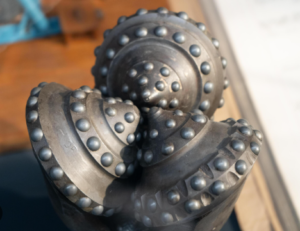
For harder and more abrasive formations, Varel offers the Hyperion line of roller cone bits. The cutting structure geometry of the Hyperion features highly optimized tungsten carbide insert layouts with carefully engineered pitch and projection lengths. The inserts on the outer rows are given a distinct chiseled profile to maintain a clean gauge diameter, while the inner rows utilize ballistic profiles to gouge and crush the center of the borehole. This targeted geometric zoning ensures that energy is deployed where it is most effective, preventing structural binding, minimizing tooth breakage, and sustaining high drilling speeds in challenging crystalline rock formations.
To clearly illustrate how the choice of cutting structure geometry and specific manufacturer models impact drilling operations, the following table summarizes performance across various geological formations commonly encountered during water well drilling.
| Formation Type | Optimal Cutting Geometry | Key Geometric Features | Recommended Manufacturer Models | Impact on Drill Speed (ROP) |
| Unconsolidated Sand & Clay | Low Density, Aggressive Shearing | Low back rake (10-15°), Large junk slots, Wide cutter spacing | Baker Hughes Talon Series, Varel Voyager | Maximum speed via high depth of cut; requires high hydraulic flow to prevent balling. |
| Medium Limestone & Shale | Moderate Density, Dual-Row Shearing | Medium back rake (15-20°), Depth-of-cut control elements | Halliburton FX53, Schlumberger Onyx 360 | Balanced speed and durability; stable ROP through variable interbedded layers. |
| Hard Sandstone & Quartzite | High Density, Impact Fracturing | High back rake (20-30°), Axe/Ridged shapes, Thick diamond tables | Schlumberger AxeBlade, Baker Hughes Kymera | Sustained moderate speed; prevents cutter chipping while maintaining rock fracture. |
| Granite & Basalt (Igneous) | Extreme Density, Crushing & Gouging | Spherical/Conical inserts, Rolling cone mechanisms, Force-balanced layouts | Varel Hyperion, Baker Hughes Kymera Hybrid | Steady, continuous speed; minimizes mechanical wear and avoids catastrophic bit failure. |
Achieving the absolute highest speed with a water drill bit requires more than just selecting the right cutting structure geometry; it demands the precise synchronization of operational drilling parameters with that geometry. Weight-on-Bit (WOB) and Rotational Speed (RPM) must be carefully tuned to match the structural characteristics of the bit face. For an aggressive cutting structure featuring low back rake angles and low cutter density, a higher RPM combined with a moderate WOB yields the best results. The high rotational speed allows the sharp cutters to rapidly slice through soft rock, utilizing their geometric advantage to clear large volumes of material very quickly.
When dealing with high-density, high-back-rake cutting structures engineered for hard rock, the strategy must shift toward a higher WOB and lower RPM. Hard rock requires immense compressive force to initiate fracturing; therefore, increasing the WOB forces the blunt or reinforced cutting profiles into the rock matrix, creating micro-fractures that weaken the structural integrity of the formation. Lowering the RPM in these scenarios reduces the severe impact shocks and thermal friction that can destroy diamond tables and carbide inserts. By maintaining this delicate balance between mechanical inputs and geometric design, operators can extract the maximum possible speed from their drill bits while preventing premature tool failure and maximizing the total depth drilled per run.

