Our Location
304 North Cardinal St.
Dorchester Center, MA 02124

304 North Cardinal St.
Dorchester Center, MA 02124

The rotary speed, measured in revolutions per minute (RPM), is a critical operating parameter in geotechnical, oil and gas, and water well drilling. When employing a tricone drill bit specifically for water well drilling or fluid-assisted penetration, selecting the correct RPM is not merely a matter of maximizing speed. Instead, it is a complex balancing act between mechanical shearing, crushing efficiency, fluid dynamics, and metallurgical endurance. A tricone bit operates on a combination of scraping, gouging, and crushing mechanisms depending on whether it is a milled tooth bit or a Tungsten Carbide Insert (TCI) bit.
Achieving what drillers refer to as a “clean cut” implies maximizing the Rate of Penetration (ROP) while minimizing borehole deviation, preventing premature cutter degradation, and ensuring efficient cuttings evacuation by the drilling fluid. If the RPM is set too low, the energy delivered to the rock formation is insufficient to exceed its compressive strength efficiently. This results in slow penetration, high mechanical vibration, and unnecessary wear on the drill rig’s top drive or rotary table. Conversely, excessively high RPM introduces devastating centrifugal forces, extreme thermal stress on the cone bearings, and a phenomenon known as “tracking,” where the teeth fall into the same grooves made during previous rotations. This reduces cutting efficiency to near zero and risks catastrophic downhole failure, such as lost cones. Therefore, determining the exact RPM requires analyzing formation hardness, bit design, weight on bit (WOB), and the hydraulics of the drilling fluid.
In soft, unconsolidated formations such as clays, shales, and loose sands, the primary cutting mechanism is gouging and scraping. Milled tooth tricone bits feature long, widely spaced teeth designed to dig deep into the formation and tear it apart. For these applications, a higher RPM paired with a moderate Weight on Bit is mathematically and practically favored. The higher rotational speed allows the long teeth to quickly slice through soft material before it can pack between the cones and cause “balling.”
In these scenarios, the ideal RPM generally ranges from 100 to 150 RPM. Because the rock compressive strength is low, the cutters do not experience extreme impact forces, allowing the bearings to tolerate higher rotational speeds without immediate overheating. However, the drilling fluid flow rate must be perfectly synchronized with this high RPM to instantly flush the massive volume of generated cuttings away from the bit face.
As the formation transitions into medium-hard strata such as limestone, sandstone, and hard shales, the cutting mechanism shifts from scraping to a combination of chipping and crushing. For these environments, drillers utilize either shorter-toothed milled bits or medium-grade Tungsten Carbide Insert (TCI) bits featuring chisel-shaped or conical inserts.
The compressive strength of the rock requires a higher WOB to force the cutters into the material, which necessitates a corresponding reduction in RPM. The optimal rotational speed for medium formations typically falls between 70 and 100 RPM. Running at this moderate speed prevents the carbide inserts from fracturing due to high-frequency impacts while maintaining a steady, clean crushing action that produces consistent, manageable rock chips.
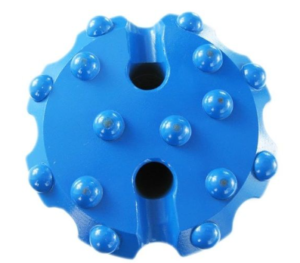
In hard, highly abrasive formations like granite, quartzite, and chert, the rock can only be broken through pure compressive crushing. Tricone TCI bits designed for hard rock feature short, blunt, hemispherical spherical inserts placed closely together. To fracture these high-compressive-strength rocks, massive Weight on Bit must be applied.
Because the load on the bit is extremely high, the rotational speed must be strictly limited to prevent the bearings from burning out and the carbide inserts from shattering under thermal shock. For hard formations, the optimal speed drops significantly to a range of 40 to 70 RPM. Lowering the RPM ensures that each insert makes solid, stable contact with the rock face, transferring the immense vertical force directly into the formation to create a clean micro-fracturing effect rather than skimming over the surface.
A clean, efficient cut cannot be achieved by adjusting RPM in isolation. It is inextricably linked to the Weight on Bit (WOB). These two parameters operate in an inverse mathematical relationship relative to formation hardness. As a general engineering rule, as the rock hardness increases, the required WOB increases, and the allowable RPM decreases.
If a driller attempts to run a high RPM alongside a high WOB in hard rock, the friction generated at the bearing journal exceeds the cooling capacity of the drilling mud, leading to total bearing seizure. On the other hand, running a high RPM with insufficient WOB results in a condition called “bit bouncing” or “skipping.” This causes severe impact damage to the cutting structures, leading to broken teeth and an uneven, unstable borehole profile. Drillers must consult the specific manufacturer’s dL charts (distance per revolution) to balance these factors, ensuring the cutting structure penetrates to its designed depth on every single rotation.
Baker Hughes is a global leader in drilling technology, renown for engineering tricone bits with advanced metallurgy and proprietary bearing designs that maximize ROP and bit life across various RPM ranges.
Model: Hughes Christensen GT-S Series
The GT-S series features premium milled tooth bits engineered primarily for soft to medium formations. These bits incorporate specialized hardfacing on the teeth to resist abrasion and utilize a highly reliable sealed journal bearing system.
Application and Design: It is widely used in water well drilling where soft shale and sand layers dominate. The design minimizes bit balling through optimized cone fluid paths.
Optimal Operating Parameters: For a standard 8-3/4 inch GT-S bit in soft clay, the recommended RPM ranges from 110 to 140 RPM, combined with a WOB of 1,000 to 3,000 lbs per inch of bit diameter. This configuration ensures rapid, clean shearing without clogging the cutting structure.
Model: Hughes Christensen Talon TCI Series
The Talon series represents the pinnacle of Tungsten Carbide Insert technology, designed to handle medium-hard to extremely hard rock formations with high mechanical efficiency.
Application and Design: These bits feature specialized insert shapes, such as chisel and scooped designs, alongside proprietary diamond-enhanced inserts on the gauge row to prevent hole under-sizing.
Operating Parameters: When encountering hard sandstone or limestone, the Talon series operates most cleanly between 60 and 90 RPM. This controlled speed protects the premium carbide inserts from impact fatigue while maximizing the crushing force delivered by the rig.
Smith Bits is globally recognized for its data-driven engineering and unique cutter geometries, focusing heavily on vibration reduction and extended bearing life during high-performance drilling operations.
Model: Smith Bits XR Series
The XR series consists of high-durability TCI tricone bits engineered specifically for extended runs in harsh, abrasive conditions often found in deep water well and geothermal projects.
Application and Design: It integrates an advanced sealed roller bearing system and unique insert configurations that minimize tracking. The premium silver-plated bearing washers reduce friction and heat buildup during long rotational cycles.
Operating Parameters: In hard, consolidated formations, the XR series delivers its cleanest cut at a focused speed of 50 to 80 RPM. This deliberate speed ensures the structural integrity of the rollers while maintaining continuous rock fracture.
Model: Smith Bits SilverSTAK
The SilverSTAK is a specialized tricone bit line optimized for operations where motor-driven or high-speed rotary systems are deployed.
Application and Design: It features an ultra-premium bearing package designed to survive higher thermal thresholds than standard bits, making it unique among tricone options.
Operating Parameters: This model can safely sustain speeds up to 120 to 160 RPM in soft-to-medium formations without suffering immediate bearing failure, providing an exceptionally clean cut when rapid fluid flushing is available.
Varel manufactures highly robust, cost-effective tricone drilling solutions widely favored in the water well, mining, and industrial drilling sectors due to their predictable performance and heavy-duty designs.
Model: Varel High Performance (HP) Series
The HP Series features open or sealed bearing milled tooth bits optimized for shallow to medium-depth water well drilling operations.
Application and Design: Built with deep, aggressive tooth profiles, these bits excel at clearing loose material out of the hole quickly.
Operating Parameters: The HP series operates best in soft formations at 90 to 130 RPM. This allows the mechanical action of the teeth to slice cleanly through the formation while preventing mud scaling on the cone shells.
Model: Varel CH Series (Crusader Hard Rock)
The CH series is Varel’s heavy-duty answer to drilling through dense, high-compressive-strength rock layers such as granite, basalt, and volcanic formations.
Application and Design: Loaded with high-grade conical and spherical tungsten carbide inserts, this bit emphasizes maximum structural toughness and severe wear resistance.
Operating Parameters: To achieve a clean, non-destructive cut in hard rock, the CH series must be run at a conservative 40 to 60 RPM, supported by maximum allowable WOB to guarantee effective rock crushing.
| Brand and Series | Bit Type | Target Formation | Recommended RPM Range | Recommended WOB (lbs/in diameter) | Primary Cutting Action |
| Baker Hughes GT-S | Milled Tooth | Soft to Medium | 110 – 140 RPM | 1,000 – 3,000 | Gouging and Scraping |
| Baker Hughes Talon | TCI | Medium to Hard | 60 – 90 RPM | 2,500 – 5,000 | Chipping and Crushing |
| Smith Bits XR | TCI | Hard to Abrasive | 50 – 80 RPM | 3,000 – 6,000 | Compressive Crushing |
| Smith Bits SilverSTAK | TCI / Milled | Soft to Medium (High Speed) | 120 – 160 RPM | 1,500 – 3,500 | Rapid Shearing |
| Varel HP Series | Milled Tooth | Soft | 90 – 130 RPM | 1,000 – 2,500 | Deep Gouging |
| Varel CH Series | TCI | Extremely Hard | 40 – 60 RPM | 4,000 – 7,000 | Pure Impact Crushing |
An often overlooked component of maintaining a clean cut is the drilling fluid dynamics, specifically the nozzle velocity and total flow rate. No matter how perfectly calibrated the RPM is, a tricone bit cannot cut cleanly if the crushed rock particles are not immediately removed from the bottom of the hole. When a tricone bit crushes rock, the generated fines can form a layer of dense slurry beneath the cones if the hydraulics are inadequate. This leads to a phenomenon called “bottom-hole balling,” where the bit simply rides on a cushion of its own cuttings, completely eliminating any real penetration.
To prevent this, the drilling fluid flow rate must be scaled alongside the RPM. When running at higher speeds (e.g., 120 RPM in soft formations), the volume of cuttings produced per second increases exponentially. Therefore, the mud pump output must be elevated to achieve a high annular velocity, sweeping the cuttings up and away from the bit face instantly. Furthermore, modern tricone bits utilize directed jet nozzles that aim the fluid stream precisely at the leading edges of the cutters and the bottom of the hole. This hydraulic action actively cuts the softer formations before the mechanical teeth even make contact, demonstrating that a “clean cut” is a joint effort between mechanical rotation and fluid erosion.
Out on the drilling rig, unexpected geological changes require immediate adjustments to operating parameters. Experienced drillers monitor surface indicators to determine whether their current RPM is delivering a clean cut or causing downhole destruction.
If the rotary speed is too high for the formation being drilled, the rig will often display specific warning signs. High-frequency vibrations traveling up the drill string, erratic torque readings on the control panel, and a sudden, sharp decline in the Rate of Penetration indicate that the bit is likely spinning out of control. In hard rock, this means the carbide inserts are skipping over the rock surface, creating excessive frictional heat that will quickly destroy the bearing seals. If a seal fails, drilling fluid enters the precision bearing race, leading to immediate mechanical lockup. The instant fix is to reduce the RPM by 20 to 30 percent and incrementally increase the WOB until the torque stabilizes and the ROP climbs.
When the RPM is configured too low for a soft, sticky formation, the symptoms are entirely different. The torque profile will become heavily loaded and steady, but the ROP will stall completely. This indicates that the teeth are sinking deeply into the soft clay or shale but are not rotating fast enough to shear the material away cleanly, causing the bit to become “balled up.” To remedy this, the driller should pick up off the bottom of the hole, increase the mud pump strokes to maximize fluid cleaning, increase the rotational speed to the upper limit of the bit’s specification, and then slowly re-apply light weight to resume a clean, efficient cutting action.

