Our Location
304 North Cardinal St.
Dorchester Center, MA 02124

304 North Cardinal St.
Dorchester Center, MA 02124

When you are working on a construction project, a water well installation, or any drilling operation that demands precision and safety, the condition of your drill bits matters enormously. A used water drill bit that appears perfectly fine on the surface may carry hidden micro-cracks that could cause catastrophic failure during operation. These micro-cracks are invisible to the naked eye, and they can propagate under the extreme heat, pressure, and torque that drilling generates. If a bit fractures mid-drill, you lose time, you lose money, you risk damaging the borehole, and in the worst case, you put your crew in danger. This guide will walk you through every inspection method, every brand and model you should know about, every tool you need, and every detail you must understand to reliably detect hidden micro-cracks in a used water drill bit before you send it back into the ground.
Micro-cracks are tiny fractures that form in the metal matrix of a drill bit, usually at stress concentration points such as the junction between the shank and the body, the brazing joints where carbide teeth are attached, or the transition zones between the crown and the gauge. These cracks are typically less than 0.5 millimeters in length when they first form, which means you cannot see them without magnification or specialized testing equipment. The danger lies in their growth. Every time the bit rotates under load, the crack tip experiences cyclic stress. This is classic fatigue loading. Even if the individual stress cycles are below the ultimate tensile strength of the material, repeated loading causes the crack to grow incrementally with each revolution. Eventually, the crack reaches a critical length, and the bit fails suddenly and completely. There is no warning. There is no gradual wear-down that you can feel. The bit simply breaks.
In water drilling applications, the stakes are even higher because you are often working in confined spaces, dealing with high-pressure water flows, and operating in environments where retrieving a broken bit is extremely difficult and expensive. A broken bit in a 200-meter water well can cost tens of thousands of dollars in fishing operations and lost drilling time. This is why inspecting used bits for micro-cracks is not optional. It is a mandatory safety and cost-control procedure.
Before you can inspect a bit effectively, you need to understand its anatomy. A typical water drill bit used in water well drilling, geotechnical investigation, or HDD (horizontal directional drilling) consists of several distinct zones, each with its own failure modes.
The Shank: This is the top portion of the bit that connects to the drill string or the drill rig. It is usually made of high-strength alloy steel. Micro-cracks here are particularly dangerous because a shank failure means the entire bit drops into the borehole. The shank is also the area most prone to fatigue cracking from the bending stresses that occur when the drill string is not perfectly straight.
The Body (or Shell): The body is the main cylindrical section of the bit. In PDC (polycrystalline diamond compact) bits, the body is steel. In roller cone bits, the body houses the cones and bearings. Micro-cracks in the body often originate from thermal cycling. Every time the bit heats up from friction and then cools down when water is applied, the metal expands and contracts. Over hundreds of cycles, this thermal fatigue creates micro-cracks, especially near the heat-affected zones around brazed joints.
The Cutting Structure: This is where the actual drilling happens. For PDC bits, this means the diamond cutters brazed onto the bit face. For roller cone bits, this means the tungsten carbide inserts on the cones. For diamond impregnated bits, this means the diamond-laden matrix. The cutting structure is the most heavily loaded part of the bit, and it is where micro-cracks most frequently initiate. Braze cracks, which are cracks in the braze layer that holds the cutters to the bit body, are extremely common and extremely dangerous because they can cause cutters to pop out under load.
The Gauge: The gauge is the outer diameter of the bit that maintains the borehole size. It is subject to constant abrasion and impact. Micro-cracks in the gauge can lead to gauge wear that is uneven, which causes the bit to walk off-center, creating a crooked borehole.
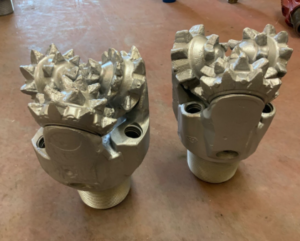
Knowing which brands and models are most common in the field will help you understand what to expect during inspection, because different manufacturers use different materials, brazing techniques, and quality control standards.
Atlas Copco is one of the most respected names in drilling equipment. Their Secoroc line includes bits for water well drilling, DTH (down-the-hole) drilling, and top-hammer drilling. The Secoroc D50 and Secoroc D65 are popular DTH bits for water well applications. These bits use tungsten carbide buttons and are known for their robust construction. Micro-cracks in Secoroc bits tend to appear in the pin connection area and around the carbide button seats. The Secoroc COP 664 is a top-hammer bit used in larger diameter water well drilling, and its braze joints between the PDC cutters and the bit body are a common crack initiation site.
Sandvik’s Coromant brand produces some of the highest-quality drill bits in the industry. Their Coromant Capto system includes modular drill heads for various applications. For water drilling, the Coromant 880 and Coromant 620 series PDC bits are widely used. Sandvik bits are known for their premium braze quality, but even these can develop micro-cracks after extended use. The SD1125 and SD1620 are specific PDC bit models used in water well and geothermal drilling. Inspectors should pay special attention to the transition ring on Sandvik bits, as this is a known stress concentration area.
Epiroc’s Diversey series includes DTH bits for water well drilling. The Diversey D525 and D625 are common models. These bits feature a unique conical button arrangement that distributes load more evenly, but the button pockets can still develop micro-cracks from impact loading.
NOV is a giant in the drilling industry. Their ReedHycalog brand produces roller cone bits and PDC bits for water well and oil/gas drilling. The ReedHycalog 425M and 525M are roller cone bits used in water well drilling. For PDC bits, the ReedHycalog 1605M and 1905M are popular in large-diameter water well applications. NOV bits use a proprietary steel alloy for their bodies, and micro-cracks in NOV bits often appear as heat-check cracks on the bit face after thermal cycling.
Kanmet is a major Chinese manufacturer of drill bits. Their KM110, KM115, and KM120 series PDC bits are very common in Asian water well drilling markets. These bits are more affordable but often use lower-grade braze materials, making them more susceptible to braze micro-cracks. If you are inspecting a Kanmet bit, you should be extra thorough in checking every braze joint.
Robit is a Finnish manufacturer known for DTH bits. Their Robit R500 and R700 series are used in water well drilling across Europe and Asia. These bits use a proprietary button geometry and are generally very durable, but the pin thread area is a known weak point for micro-crack initiation.
Miracle is another major Chinese brand. Their DC515, DC520, and DC525 PDC bits are popular in small to medium water well drilling. These bits are budget-friendly but require careful inspection because the quality control can be inconsistent. Micro-cracks in Miracle bits are frequently found in the gauge pad braze joints.
Bethel produces the BT110, BT115, and BT120 series PDC bits. These are commonly used in shallow water well drilling in China and Southeast Asia. The braze quality on Bethel bits varies significantly between production batches, so inspection is critical.
Tamrock DTH bits, particularly the D65 and D80 models, are legendary in the water well drilling world. They are known for longevity, but even these premium bits develop micro-cracks in the shank-to-body transition after 500 to 800 meters of drilling in hard rock.
Visual inspection is the simplest and most accessible method, but it is also the least sensitive. You will not find micro-cracks with the naked eye, but you can find the conditions that lead to micro-cracks, and you can find macro-cracks that have grown from micro-cracks.
What to look for:
Start by cleaning the bit thoroughly. Use a wire brush to remove all mud, scale, and debris. Then examine the bit under good lighting, preferably with a 10x to 20x magnifying glass or a jeweler’s loupe. Look at the shank threads for any signs of cracking or deformation. Check the pin box (the connection point at the top of the bit) for hairline cracks radiating from the corners. Examine every braze joint on PDC bits. A healthy braze joint is smooth, uniform, and silver or gold in color. A compromised braze joint will show discoloration, porosity, or a visible gap between the cutter and the bit body. On roller cone bits, check the journal bearings for pitting and the cone surfaces for spalling. Look at the gauge pads for uneven wear, which can indicate that micro-cracks have caused premature failure in specific areas.
Limitations of visual inspection:
Visual inspection can only detect cracks that are larger than about 0.2 to 0.3 millimeters. Anything smaller is invisible without magnification, and even with magnification, surface cracks can be hidden by surface roughness or oxidation. This is why visual inspection should always be combined with other methods.
Magnetic Particle Inspection, also known as Magnetic Particle Testing (MT), is one of the most effective methods for finding micro-cracks in ferromagnetic drill bits. Most water drill bits are made of steel, which is ferromagnetic, so MPI is applicable to the vast majority of bits you will encounter.
How it works:
You magnetize the bit by running an electric current through it or by placing it in a strong magnetic field. If there is a crack anywhere near the surface, the magnetic field lines will be distorted at the crack location. This distortion creates a leakage field that attracts fine iron particles (either dry powder or wet suspension) that you have applied to the bit surface. The particles gather at the crack, forming a visible indication that reveals the crack’s location, length, and orientation.
Procedure for drill bit inspection:
First, clean the bit surface thoroughly. Any oil, grease, or scale will interfere with particle movement. Then apply the magnetic particles. For drill bits, the wet method (using particles suspended in oil or water) is generally preferred because it provides better sensitivity and better coverage of complex geometries. You need to magnetize the bit in at least two different directions (longitudinal and circular) to ensure you detect cracks in all orientations, because a crack that is parallel to the magnetic field will not produce a leakage field and will be invisible. After magnetization, examine the bit under UV light (if using fluorescent particles) or under white light (if using visible particles). Look for linear indications that follow the shape of a crack.
Sensitivity: MPI can detect cracks as small as 0.01 millimeters in depth, which makes it far superior to visual inspection. However, it only works on ferromagnetic materials, so it will not work on PDC cutter surfaces (which are diamond, not steel) or on non-ferrous gauge pads.
Dye Penetrant Inspection, also called Liquid Penetrant Testing (PT), is the go-to method for inspecting non-ferrous surfaces on drill bits, such as PDC cutter faces, tungsten carbide inserts, and non-ferrous gauge pads.
How it works:
You apply a colored or fluorescent dye to the cleaned surface. The dye seeps into any open cracks by capillary action. After a dwell time (usually 5 to 30 minutes), you remove the excess dye from the surface. Then you apply a developer, which draws the trapped dye out of the crack and makes it visible as a bright line against a contrasting background.
Procedure for drill bit inspection:
Clean the bit surface meticulously. Apply the penetrant and allow it to dwell. Wipe off the excess. Apply the developer. Examine under white light (for visible dye) or UV light (for fluorescent dye). On PDC bits, pay special attention to the braze joints and the edges of the cutters, as these are the most common crack locations.
Sensitivity: DPI can detect cracks as small as 0.005 millimeters wide, making it extremely sensitive. However, it only detects cracks that are open to the surface. Subsurface cracks that have not yet broken through to the surface will not be detected.
Ultrasonic Testing is the most powerful non-destructive testing method for finding subsurface micro-cracks that neither visual inspection nor MPI/DPI can detect. This is the method you use when you need to know, with high confidence, whether a bit is safe to use.
How it works:
An ultrasonic transducer sends high-frequency sound waves (typically 2 to 10 MHz) into the material. When the sound wave encounters a crack, part of the energy is reflected back to the transducer. By analyzing the time and amplitude of the reflected signal, you can determine the depth, size, and orientation of the crack.
Procedure for drill bit inspection:
You need a coupling medium (gel or oil) to transmit the ultrasonic waves into the bit. Place the transducer on the shank, the body, and the transition areas. Scan systematically in a grid pattern. Look for echo signals that appear between the initial pulse and the back-wall echo. These intermediate echoes indicate the presence of a reflector, which is likely a crack. Advanced UT systems can produce C-scan images that show the crack location and size in a two-dimensional map.
Sensitivity: UT can detect cracks as small as 0.1 millimeters in length at depths of up to 100 millimeters. This makes it the gold standard for subsurface crack detection. The limitation is that it requires trained operators and expensive equipment, and complex geometries (like the cutter face of a PDC bit) can produce confusing signals.
Eddy Current Testing is a fast, non-contact method that is excellent for screening large numbers of bits quickly. It works by inducing electrical currents (eddy currents) in the conductive material of the bit. Cracks disrupt the flow of these currents, which changes the impedance of the test coil. This change is detected and displayed as a signal.
How it works:
You pass a probe over the surface of the bit. The probe contains a coil that generates an alternating magnetic field. This field induces eddy currents in the bit. If there is a crack, the eddy current path is disrupted, and the coil’s impedance changes. The instrument displays this change as a signal on a screen.
Procedure for drill bit inspection:
ECT is best used on the shank and body of steel bits. It is less effective on PDC cutter faces because the diamond is not conductive. Use a probe with a frequency appropriate for the depth you want to inspect (higher frequency for shallow cracks, lower frequency for deeper cracks). Scan the entire surface systematically.
Sensitivity: ECT can detect surface cracks as small as 0.05 millimeters. It is very fast, making it ideal for high-volume screening. However, it requires calibration for each bit geometry, and it cannot detect deep subsurface cracks.
Infrared thermography is not a primary inspection method for micro-cracks, but it can be a useful supplementary tool. When you heat a bit (for example, by running it in a drill rig for a short time or by using a heat gun), areas with micro-cracks will cool down faster than sound areas because the cracks act as thermal barriers. An infrared camera can detect these temperature differences.
Limitations: This method is qualitative, not quantitative. It can tell you where to look more closely, but it cannot tell you the exact size or depth of the crack. Use it as a triage tool, not a definitive inspection method.
Now that you know all the methods, here is the recommended workflow for inspecting a used water drill bit.
Step 1: Documentation and Cleaning. Record the bit’s brand, model, serial number, total footage drilled, and the formation it was used in. Clean the bit thoroughly with a wire brush and solvent. This step is critical because contamination will ruin every subsequent test.
Step 2: Visual Inspection with Magnification. Use a 10x to 20x magnifier to examine the entire bit. Document any visible damage, wear patterns, or discoloration. This step takes 5 to 10 minutes per bit.
Step 3: Magnetic Particle Inspection (if ferromagnetic). Magnetize the bit in two perpendicular directions. Apply wet magnetic particles. Inspect under appropriate lighting. Document any indications. This step takes 15 to 30 minutes per bit.
Step 4: Dye Penetrant Inspection (for non-ferrous surfaces). Apply penetrant to PDC cutter faces, carbide inserts, and non-ferrous gauge pads. Develop and inspect. This step takes 20 to 40 minutes per bit.
Step 5: Ultrasonic Testing (for critical bits or bits with suspicious indications from steps 2-4). Perform a full UT scan of the shank, body, and transition zones. Analyze the A-scan and C-scan images. This step takes 30 to 60 minutes per bit and requires a trained operator.
Step 6: Decision. If any micro-crack is detected, the bit must be repaired (if the crack is in a non-critical area and repair is feasible) or retired. Do not send a bit with confirmed micro-cracks back into the hole. The cost of failure far exceeds the cost of a new bit.
Different bit types have different crack patterns, and you need to adjust your inspection focus accordingly.
For PDC Bits (Secoroc COP 664, Sandvik SD1125, Kanmet KM110, Miracle DC515, Bethel BT110): The primary concern is braze cracks. The braze layer between the PDC cutter and the bit body is typically only 0.1 to 0.3 millimeters thick, and it is the weakest link. Use DPI on every cutter. Use UT to scan the bit body beneath the cutters for subsurface cracks that may have propagated from failed braze joints. Also check the cutters themselves for impact cracks, which appear as dark lines on the diamond surface.
For Roller Cone Bits (NOV ReedHycalog 425M, Tamrock D65): The primary concerns are journal bearing cracks, cone cracking, and tooth (insert) cracking. Use MPI on the steel body and cones. Use UT on the journal areas. Visually inspect every carbide insert for chips and cracks. Roller cone bits also develop heat-check cracks on the cone faces after drilling in hard, abrasive formations.
For DTH Bits (Atlas Copco Secoroc D50, Epiroc Diversey D525, Robit R500): The primary concerns are button pocket cracks and pin thread cracks. The button pockets are subjected to extreme impact loading, and cracks often initiate at the pocket corners. Use MPI on the entire bit face. Use UT on the pin thread area. DTH bits also suffer from shank fatigue cracks, so always UT the shank.
For Diamond Impregnated Bits (used in soft to medium formations): These bits have a different failure mode. The diamond matrix can develop radial cracks from thermal shock. Use UT to scan the entire bit body. Visual inspection under magnification can reveal matrix spalling, which is a precursor to deeper cracking.
The frequency of inspection depends on the drilling conditions and the bit type. As a general rule, inspect every bit after every 500 meters of drilling in hard rock, or every 1000 meters in soft to medium rock. For PDC bits used in abrasive formations, inspect after every 200 to 300 meters. For DTH bits, inspect after every 300 to 500 meters. If you notice any change in drilling performance (increased torque, decreased ROP, unusual vibration), stop and inspect the bit immediately regardless of the footage.
The most common mistake is relying on visual inspection alone. As we have discussed, visual inspection cannot detect micro-cracks. The second most common mistake is skipping the second magnetization direction in MPI. If you only magnetize in one direction, you will miss cracks that are parallel to that direction. The third mistake is not cleaning the bit before testing. Any contamination will mask indications and give you false confidence. The fourth mistake is ignoring the shank. Most inspectors focus on the bit face and forget that shank fatigue cracks are the most common cause of dropped bits. The fifth mistake is reusing a bit with a repaired crack. If a crack is found, the bit should be retired. Repair welding introduces heat-affected zone cracks that are even harder to detect.
If you are running a drilling operation and you want to implement a proper inspection program, here is the minimum equipment you need. A 10x to 20x magnifying glass or loupe costs under 50andisessentialforvisualinspection.Amagneticparticleinspectionkit(includingyoke,particles,UVlight,andcleaner)costsbetween500 and 2000dependingonquality.Adyepenetrantinspectionkitcostsbetween200 and 800.Anultrasonicflawdetectorwithappropriatetransducerscostsbetween5000 and 20000.Aneddycurrentinstrumentcostsbetween3000 and $15000. For most small to medium operations, a magnifier, MPI kit, and DPI kit are the minimum viable setup. For large operations with high-value bits, invest in UT and ECT.
Some operators skip inspection to save time and money. This is a false economy. A new PDC bit costs between 500and5000 depending on size and brand. A fishing operation to retrieve a broken bit from a 200-meter water well costs between 2000and10000. The lost drilling time can cost 500to2000 per day. A single bit failure can easily cost 10000to30000. Inspecting a bit takes 30 to 90 minutes and costs almost nothing in consumables. The return on investment is enormous. Every minute you spend inspecting a bit saves you potentially thousands of dollars.
Inspecting a used water drill bit for hidden micro-cracks is not rocket science, but it does require discipline, the right tools, and an understanding of where cracks are most likely to form. By combining visual inspection, magnetic particle testing, dye penetrant testing, ultrasonic testing, and eddy current testing in a systematic workflow, you can catch micro-cracks before they become catastrophic failures. Know your bits. Know your brands. Know your methods. And never send a bit back into the hole unless you are confident it is crack-free. The ground does not forgive carelessness, and neither does your budget.

