Our Location
304 North Cardinal St.
Dorchester Center, MA 02124

304 North Cardinal St.
Dorchester Center, MA 02124

Drill bit diameter is one of the most important factors affecting drilling performance. Whether you are drilling metal, stainless steel, aluminum, wood, plastic, or other materials, choosing the correct drill bit diameter can significantly influence drilling speed, cutting efficiency, hole accuracy, surface quality, tool life, and overall production costs.
A drill bit that is too small may not produce the required hole size, while an oversized drill bit can create excessive cutting resistance, increase heat generation, and damage the workpiece. Understanding the relationship between drill bit diameter and drilling performance helps operators select the right cutting tool for different applications.
In this guide, we will explain how drill bit diameter affects drilling speed, torque, cutting force, heat, hole quality, and tool durability.
Drill bit diameter directly influences the cutting conditions during drilling. Larger drill bits generally require more cutting power because they remove more material and create greater cutting resistance.
However, drilling speed is not determined by diameter alone. It also depends on spindle speed, cutting speed, workpiece material, feed rate, drill bit geometry, and machine power.
For a given cutting speed, the spindle speed must decrease as drill bit diameter increases.
The spindle speed can be calculated using the following formula:
RPM = (Cutting Speed × 1000) / (π × Drill Bit Diameter)
Where:
For example, when drilling steel at a cutting speed of 30 meters per minute:
This demonstrates that larger drill bits generally require lower spindle speeds to maintain the appropriate cutting speed.
Using an excessively high RPM with a large-diameter drill bit can cause overheating, accelerated cutting-edge wear, and premature tool failure.
Drill bit diameter has a significant effect on the cutting force and torque required during drilling.
In general, larger drill bits require more torque because they engage more material and create greater resistance during the cutting process.
When drilling thick metal plates or hard materials, a large-diameter drill bit may require a more powerful drilling machine.
The relationship between diameter and torque is particularly important in industrial applications.
Small-Diameter Drill Bits
Small drill bits generally require less torque and are suitable for precision drilling, small holes, and applications involving thinner materials.
Common applications include:
Large-Diameter Drill Bits
Large drill bits generally require greater torque and machine stability. They are commonly used for larger holes in structural steel, industrial machinery, metal fabrication, and construction applications.
If the machine does not provide sufficient torque, the drill bit may slow down, vibrate, overheat, or become stuck in the workpiece.
Selecting the correct diameter helps maintain stable drilling conditions and improves machining efficiency.
Heat generation is another important factor influenced by drill bit diameter.
During drilling, friction between the cutting edges and the workpiece produces heat. Larger drill bits can generate more total heat because they remove more material and require greater cutting power.
Excessive heat can lead to several problems:
When drilling stainless steel, alloy steel, and other difficult-to-machine materials, controlling heat is particularly important.
To reduce heat generation:
For larger drill bits, proper chip removal and cooling become especially important because heat can accumulate around the cutting edges and inside deeper holes.
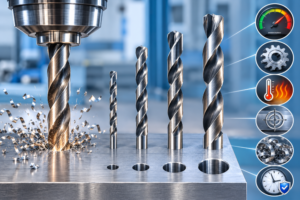
Drill bit diameter directly determines the nominal hole size. However, the actual hole diameter may differ slightly from the drill bit’s specified diameter.
Several factors influence hole accuracy:
Small-diameter drill bits are often used for precision holes, but they can also be more vulnerable to bending and breakage.
Large-diameter drill bits are generally more rigid, although their cutting forces can cause machine deflection or workpiece movement if the setup is unstable.
For applications requiring highly accurate hole dimensions, operators should consider using a pilot hole, reaming, or other finishing operations.
It is also important to distinguish between drill bit diameter and final hole diameter. A drilled hole may be slightly larger than the nominal drill bit size because of runout, cutting geometry, or material behavior.
Chip removal becomes increasingly important as drill bit diameter and drilling depth increase.
During drilling, the cutting edges remove material and produce chips. These chips must travel out of the hole through the drill bit’s flutes.
If chips cannot escape efficiently, they may accumulate inside the hole and cause:
Large-diameter drill bits can produce larger volumes of chips, making efficient chip evacuation essential.
The flute design, helix angle, cutting-edge geometry, and drilling depth all influence chip removal performance.
For deep-hole drilling, operators may need to use peck drilling cycles or specialized drill bits with internal coolant channels.
Choosing the appropriate drill bit diameter and flute configuration helps maintain stable cutting performance.
Drill bit diameter can influence tool life through cutting force, heat generation, vibration, and mechanical stress.
Small-diameter drill bits are relatively fragile and may break when exposed to excessive feed pressure, misalignment, or vibration.
Large-diameter drill bits are generally more robust, but they may experience greater cutting loads and heat generation.
The actual service life depends on several factors:
For example, high-speed steel (HSS) drill bits are widely used for general-purpose drilling, while cobalt HSS drill bits offer improved heat resistance for demanding metalworking applications.
Solid carbide drill bits provide excellent hardness and wear resistance and are suitable for high-performance machining when machine rigidity and operating conditions are appropriate.
Selecting the right drill bit material for the diameter and workpiece material can significantly improve tool life.
Different materials respond differently to drill bit diameter and cutting conditions.
Stainless steel is relatively difficult to machine because of its toughness and tendency to work-harden.
When using larger drill bits, operators should carefully control spindle speed, feed rate, and cooling.
Cobalt HSS and carbide drill bits are common choices for demanding stainless steel applications.
Aluminum is relatively soft and has good thermal conductivity. However, it can produce long, sticky chips that may accumulate around the cutting edges.
Larger drill bits require appropriate flute geometry and chip evacuation to prevent clogging.
Carbon steel is widely used in industrial manufacturing and metal fabrication.
The appropriate drill bit diameter depends on the required hole size, steel grade, material thickness, and machine capabilities.
HSS, cobalt, and carbide drill bits can all be used depending on the cutting conditions.
When drilling wood and plastic, diameter affects cutting resistance, hole appearance, and material removal.
Large-diameter holes may require specialized drill bits to prevent tearing, cracking, melting, or deformation.
Choosing the correct cutting geometry is essential for achieving clean holes.
The following table summarizes the main differences between small- and large-diameter drill bits.
| Performance Factor | Small-Diameter Drill Bits | Large-Diameter Drill Bits |
|---|---|---|
| Typical application | Small precision holes | Large industrial holes |
| Required torque | Generally lower | Generally higher |
| Spindle speed | Generally higher | Generally lower |
| Material removal | Lower volume | Higher volume |
| Chip production | Generally lower | Generally higher |
| Heat management | Important | Particularly important |
| Tool rigidity | More vulnerable to bending | Generally more rigid |
| Breakage risk | Sensitive to bending and excessive feed | Sensitive to high torque and cutting loads |
| Machine requirements | Lower power in many applications | Often requires higher power |
| Hole size | Small holes | Large holes |
Neither small nor large drill bits are universally better. The ideal diameter depends on the required hole dimensions, workpiece material, production requirements, and machine specifications.
Choosing the right drill bit diameter is essential for obtaining accurate holes and maintaining efficient production.
Consider the following factors when selecting a drill bit.
Start by identifying the exact hole diameter required by the engineering drawing or manufacturing specification.
Do not select a drill bit based only on visual estimation.
Different materials require different cutting conditions.
Stainless steel, carbon steel, aluminum, copper, wood, and plastic have different hardness, toughness, and cutting characteristics.
Make sure the drilling machine can provide sufficient torque and spindle power for the selected drill bit diameter.
Using a large drill bit on an underpowered machine may result in unstable cutting conditions.
Common drill bit materials include:
The best choice depends on workpiece hardness, cutting speed, production volume, and cost requirements.
Deep holes require effective chip evacuation and cooling.
A drill bit with an unsuitable flute design may struggle to remove chips, even when its diameter is correct.
Always adjust spindle speed and feed rate according to drill bit diameter, workpiece material, and manufacturer’s recommendations.
Correct cutting parameters help reduce heat, improve hole quality, and extend tool life.
A larger drill bit can improve productivity when a larger hole is required, but increasing diameter does not automatically make drilling more efficient.
For example, drilling a 20 mm hole directly with an appropriate drill bit may be more efficient than creating the same hole through several smaller drilling operations.
However, large-diameter drilling requires sufficient machine power, stable workpiece clamping, suitable cutting geometry, and effective chip removal.
In some applications, using a pilot hole before drilling a larger hole can improve positioning and reduce the load on the cutting tool.
The best drilling strategy depends on the material, hole depth, machine capacity, and production requirements.
Avoid these common mistakes to improve drilling performance and reduce unnecessary tool replacement.
Choosing the Wrong Diameter
An incorrect diameter can produce holes that do not meet assembly or engineering requirements.
Using Excessive Spindle Speed
Large drill bits operating at excessive RPM can generate excessive heat and wear rapidly.
Ignoring Machine Torque
A machine that cannot provide sufficient torque may struggle when using large-diameter drill bits.
Ignoring Chip Evacuation
Poor chip removal can cause overheating, tool jamming, and damaged holes.
Applying Excessive Feed Pressure
Excessive feed pressure can damage cutting edges and cause drill bit breakage, particularly with small-diameter tools.
Using the Wrong Drill Bit Material
A general-purpose drill bit may not provide sufficient wear resistance or heat resistance for demanding industrial materials.
Drill bit diameter has a direct influence on drilling performance, including spindle speed, torque, cutting force, heat generation, chip removal, hole accuracy, and tool life.
Small-diameter drill bits are suitable for small precision holes and applications requiring less cutting power. Large-diameter drill bits are designed for larger holes but generally require lower spindle speeds, greater torque, and more effective cooling and chip evacuation.
To achieve the best drilling results, always consider the workpiece material, required hole size, drilling depth, machine capacity, drill bit material, and cutting parameters.
Selecting the correct drill bit diameter is not simply about matching the hole size. It is about balancing cutting efficiency, machining accuracy, tool durability, and production costs.
Xiangriyang provides information and product resources related to industrial drill bits, metalworking tools, and professional cutting solutions.
Whether you need drill bits for stainless steel, carbon steel, aluminum, sheet metal, or other industrial materials, choosing the right cutting tool is essential for achieving accurate holes and reliable machining performance.
At www.xiangriyang.com, you can explore different drill bit types, specifications, materials, diameters, and industrial drilling applications.
From HSS drill bits and cobalt drill bits to carbide cutting tools and specialized industrial drill bits, Xiangriyang aims to help customers understand drilling technologies and identify suitable cutting tools for their manufacturing requirements.
Visit www.xiangriyang.com to explore professional drill bits, compare specifications, and find suitable drilling solutions for your industrial applications.

