Our Location
304 North Cardinal St.
Dorchester Center, MA 02124

304 North Cardinal St.
Dorchester Center, MA 02124

Deep hole drilling, geothermal exploration, and water well creation all depend heavily on the performance and longevity of the drilling assembly. At the very edge of this engineering process sits the drill bit, a component subjected to immense mechanical stress, extreme friction, and destructive thermal loads. When drilling through hard rock formations like granite, basalt, or reinforced concrete, the thermal energy generated at the cutting edge escalates within seconds. Without an optimized, carefully calculated fluid management strategy, this heat triggers rapid thermal degradation, structural fatigue, and catastrophic bit failure. Water serves as the primary lifeblood of this operation, functioning simultaneously as a coolant, a lubricant, and a transport mechanism to flush away heavy drill cuttings. Optimizing this fluid flow requires an intricate understanding of hydraulic pressure, volumetric flow rates, nozzle geometry, and the unique cooling requirements of various heavy-duty drilling systems available in the industry today.
During drilling operations, mechanical energy transforms into thermal energy via two primary channels: the crushing or shearing of the rock matrix and the friction generated between the drill bit matrix and the rock face. As the cutters—whether they are made of tungsten carbide or industrial diamonds—force their way into the formation, the localized temperature at the contact zones can surpass several hundred degrees Celsius. This sudden thermal spike alters the physical properties of the drilling materials, causing micro-fracturing and structural softening.
If the water flow is insufficient, uneven, or interrupted, the rapid expansion and subsequent cooling cycles lead to thermal shocking. Thermal shocking results in micro-cracks across the cutters, causing them to shatter prematurely under normal mechanical impact. Therefore, maintaining a highly uniform, continuous boundary layer of water across the entire face of the bit is necessary to absorb and transfer heat away before it penetrates the core steel or matrix of the cutting tool.
Optimizing water flow is not merely about lowering the temperature at the drilling face; it is also about clearing the path for the drill bit to work efficiently. When water drops down the center of the drill string and exits through the flushing ports of the bit, it must carry away the newly created rock chips and fine silt, known as drill cuttings. If the volumetric flow rate or fluid velocity is too low, these dense cuttings settle at the bottom of the hole.
The drill bit then ends up grinding the same rock chips repeatedly instead of cutting new formation material. This regrinding process exponentially increases friction and heat generation, rendering standard cooling efforts ineffective. Consequently, the water flow must be calibrated to provide enough velocity within the annular space—the gap between the outside of the drill pipe and the borehole wall—to lift the cuttings completely out of the hole while continuously absorbing thermal energy from the cutting elements.
The physical design of the fluid paths within the drill bit plays a decisive role in cooling efficiency. Modern heavy-duty drill bits are engineered with specialized fluid courses, junk slots, and replaceable nozzles designed to direct water precisely where heat generation peaks. The geometry of these paths dictates the transition from smooth, laminar fluid flow to high-energy, turbulent flow.
While laminar flow moves smoothly, turbulent fluid flow breaks up boundary layers more effectively, allowing for a much higher rate of heat transfer between the hot metal or diamond surfaces and the water. Additionally, the sizing of the nozzles controls the pressure drop across the bit face. Selecting nozzles that are too large reduces the fluid velocity, causing the water to ooze out sluggishly and fail to clear debris or cool the cutters. Conversely, nozzles that are too small create extreme backpressure, which can strain the mud pumps and cause premature wear on the fluid seals without providing any added thermal relief to the cutting edge.
Achieving the perfect balance of water delivery requires continuous measurement and adjustment of the volumetric flow rate, typically measured in gallons per minute or liters per minute. The optimal flow rate depends directly on the hole diameter, the rotation speed of the drill string, and the hardness of the formation being drilled. For larger hole diameters, a greater volume of water is required to maintain the necessary upward velocity in the wide annular space.
Drillers must monitor their pump strokes and flow meters closely to ensure that the fluid volume matches the penetration rate of the bit. If the drill bit advances rapidly through a softer, high-yield formation, the flow rate must be increased to match the surge in cutting volume. This prevents the formation of a thick mud cake around the bit, which would otherwise trap heat and cause the drilling assembly to bind or overheat.
Pump pressure works hand-in-hand with flow volume to maintain a stable, cooling environment at the bottom of the hole. The pressure must be high enough to overcome the friction losses inside the long drill string and force the water out of the bit nozzles at high speeds. This creates a powerful crossflow effect across the cutting face, washing over individual cutters to strip away thermal energy instantly.
However, excessive pump pressure can erode the borehole wall in softer formations, leading to cave-ins and stuck drill pipes. Drillers must optimize the hydraulic horsepower at the bit, ensuring that the kinetic energy of the water exiting the nozzles is fully utilized for cooling and cleaning without compromising the mechanical integrity of the borehole itself.
A simple yet highly effective way to assess cooling performance is by tracking the temperature differential between the input water entering the drill string and the output water returning to the surface. A healthy drilling operation typically exhibits a steady, predictable rise in returning water temperature, indicating that the fluid is successfully absorbing heat from the bottom of the hole.
If the returning water temperature spikes suddenly, it indicates a critical drop in flow efficiency, a blocked nozzle, or a sudden transition into a much harder rock layer that generates immense friction. Conversely, if the temperature differential drops to near zero while drilling is actively underway, it suggests that the water is bypassing the cutting face entirely, possibly due to a washout or a crack in the drill pipe above the bit, leaving the cutters vulnerable to immediate thermal failure.
Optimizing water flow requires selecting a drill bit designed with advanced fluid engineering. The global drilling industry relies on several specialized manufacturers that produce high-performance bits featuring advanced hydraulic designs, specialized nozzle configurations, and high-strength materials to maximize cooling efficiency.
Baker Hughes stands as a leader in industrial drilling technology, engineering bits that handle extreme thermal and mechanical loads in deep exploration and well construction. Their engineering focus centers heavily on hydraulic optimization and advanced material selection.
Talon High-Efficiency PDC Bits: The Talon product line is engineered with advanced Polycrystalline Diamond Compact cutters and optimized fluid hydraulics. These bits feature a specialized blade profile and custom-positioned nozzles that direct high-velocity water streams precisely across the face of each cutter. This specific hydraulic layout minimizes dead zones where heat could build up, ensuring uniform cooling across the entire face of the bit even during high-RPM operations in abrasive formations.
Quantec Advanced Tricone Bits: For harder, highly erratic rock layers, the Quantec series utilizing roller cone technology offers exceptional durability. These bits are designed with a direct center flushing port alongside standard outer nozzles. This configuration provides a powerful stream of water that cools the internal bearings of the roller cones while simultaneously washing the cutting teeth, preventing heat buildup within the mechanical joints of the bit assembly.
Schlumberger, through its dedicated Smith Bits division, produces exceptionally reliable drilling tools. Their designs utilize advanced fluid simulation software to ensure that water flow patterns match the thermal profile of the bit during active drilling.
AxeBlade Ridged Diamond Element Bits: The AxeBlade series utilizes unique, ridge-shaped diamond cutters that shear rock more efficiently than traditional flat cutters. Because of this shearing action, mechanical friction is reduced, but the localized thermal load remains high. Schlumberger pairs this geometry with a customized fluid course design that maximizes crossflow velocity, ensuring that water sweeps rapidly across the ridged surfaces to remove heat and prevent thermal degradation of the diamond elements.
Stinger Conical Diamond Element Bits: Engineered for high-impact and highly abrasive environments, Stinger bits use thick, conical diamond inserts. The placement of fluid ports in these bits is highly targeted, allowing drillers to use interchangeable nozzles to customize the fluid exit velocity based on the specific capacity of their surface mud pumps, providing flexible and precise cooling management.
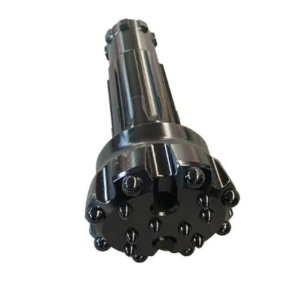
Halliburton has long been an innovator in drill bit design, focusing heavily on reducing cutter wear through advanced thermal management and optimized fluid dynamics.
MegaForce Directional PDC Bits: The MegaForce lineup is designed to maintain cutting efficiency during directional and horizontal drilling, where water flow can become uneven due to gravity pushing cuttings to one side of the hole. These bits feature asymmetric fluid courses that balance the flow of water, ensuring that even when the drill string is resting against the bottom of a horizontal borehole, water is evenly distributed to cool all cutting surfaces effectively.
Geos Diamond Matrix Bits: Built for extremely abrasive and hot geothermal formations, the Geos series features a solid matrix body infused with industrial diamond material. The entire body is crisscrossed with deep, wide junk slots and smooth fluid pathways designed to handle high volumetric flow rates without causing fluid erosion on the bit body itself, allowing drillers to run high-volume cooling pumps continuously.
For mining, water well construction, and geotechnical exploration, Epiroc provides highly specialized bits engineered to perform reliably under varied surface conditions.
Omega Sealed Bearing Rotary Bits: The Omega series is built to handle the rigorous demands of water well drilling. These bits feature an optimized internal cooling layout where a portion of the injected water is channeled through internal passages to cool the critical bearing assemblies before exiting through the main cutting face nozzles. This dual-purpose flow design prevents internal bearing seizure, which is a leading cause of tricone bit failure.
Copprod High-Velocity DTH Bits: Designed for Down-The-Hole hammer drilling, these bits operate alongside high-pressure air and water mist systems. The flushing grooves on the outer skirt of the Copprod bits are widened and streamlined to allow the compressed air and water mixture to escape rapidly, carrying heat away from the face and ensuring the impact face remains clean and cool.
Sandvik is renowned for its metallurgy and advanced tool designs tailored for mining and heavy rock excavation.
RR440 Premium Rotary Bits: The RR440 product line features an advanced structural design with a focus on bearing protection and cutter cooling. It utilizes specialized, multi-stage nozzles that create a highly turbulent spray pattern. This spray pattern spreads water across a wider surface area of the cutting cones compared to standard solid-stream nozzles, providing excellent thermal protection in highly heat-conductive rock types like quartzite.
Alpha 330 Threaded Button Bits: Used primarily in top-hammer production drilling, the Alpha 330 features a unique rigid front design with strategically placed flushing holes. The fluid channels are angled outward to ensure that water immediately sweeps across the perimeter buttons, which experience the highest linear speeds and friction loads during rotation, preventing premature flat-spotting caused by thermal softening.
Before lowering the drilling assembly into the borehole, a precise calculation of the nozzle sizes must be completed based on the total flow capacity of the surface pumps and the depth of the target well. Drillers should use a caliper or specialized nozzle gauges to verify the inner diameter of each interchangeable nozzle insert.
It is vital to install a combination of nozzles that generates the ideal pressure drop across the bit face—typically between 500 to 1,000 pounds per square inch for high-performance applications. Mixing different nozzle sizes can sometimes help balance fluid distribution across asymmetric bit blades, but this requires precise hydraulic modeling to prevent creating low-pressure zones where cuttings can accumulate and heat can build up.
Once the nozzles are securely installed, the drill string should be flushed at low pressure while still above the ground or at the surface level to verify that all fluid courses are entirely clear of debris, dried drilling mud, or storage grease. After confirming a clean, unobstructed flow pattern from all ports, the operator can lower the assembly and initialize the mud pumps to establish the baseline volumetric flow rate.
This baseline flow must be maintained consistently before the bit makes physical contact with the bottom of the hole. This step guarantees that a stabilizing cushion of moving water is already active, cooling the cutters the exact instant friction generation begins.
As drilling progresses, the operator must carefully manage the interaction between the mechanical force applied downward, known as the Weight on Bit, the rotational speed in Revolutions Per Minute, and the water flow rate. If the mechanical force or rotational speed is increased to accelerate the penetration rate, the water flow rate must be scaled upward in parallel.
Increasing the mechanical input generates heat faster, which demands a greater volume of cooling fluid to absorb and carry away that thermal energy. Operators must continuously monitor the surface pump pressure gauges; a sudden drop in pressure often indicates that a nozzle has fallen out, while a sudden spike suggests that a fluid course has become plugged with rock fragments, requiring immediate corrective action to avoid burning out the bit cutters.
Maintaining an optimized water flow is an ongoing process that extends far beyond pump adjustments. The quality of the drilling fluid itself must be carefully maintained. If the drilling water contains high amounts of abrasive sand or recycled silt, it acts like a high-velocity sandblaster as it exits the nozzles. This abrasive fluid quickly erodes the nozzles and washes out the steel body of the drill bit, destroying the carefully engineered fluid pathways.
To prevent this, drillers must utilize reliable mud cleaning systems, shale shakers, and desanders at the surface to extract fine particulates before the water is pumped back down the drill hole. Additionally, regular physical inspections of the bit body between runs are required to detect early signs of fluid erosion around the nozzle pockets, allowing for repairs before structural failure occurs.
When a drill bit is pulled from a hole, a detailed examination of the wear patterns on the cutters can provide invaluable feedback regarding the effectiveness of the water flow optimization strategy. If the cutters show smooth, even abrasive wear across their surfaces, the water hydraulics were likely well-balanced, keeping the bit cool and clean throughout the run.
However, if the cutters exhibit micro-cracking, spalling, or circular fracture rings, it indicates that the bit suffered from localized overheating and thermal shocking during operation. Finding these thermal marks on cutters located near the center of the bit body suggests that the center flushing port was likely underperforming or blocked. If the wear is concentrated on the outer gauge cutters, it shows that the outer nozzle spray velocity was insufficient to protect the high-speed perimeter elements.
A common challenge in water flow optimization is navigating transitions between highly varied geological formations. For example, moving from a hard, brittle limestone layer directly into a soft, sticky clay seam completely alters the hydraulic dynamics within the borehole. Clay formations generate less abrasive heat but can absorb water quickly, swelling up and packing into the junk slots of the bit—a condition often called bit balling.
When a bit becomes balled with clay, the water flow becomes blocked, preventing fluid from reaching and cooling the cutters when the bit enters the next hard rock layer. To prevent this, drillers should introduce specific polymer additives to the water supply when drilling through clay sections. These additives help slick the surfaces of the bit, allowing the water flow to easily wash away sticky materials and keep the pathways open for effective thermal cooling.

