Our Location
304 North Cardinal St.
Dorchester Center, MA 02124

304 North Cardinal St.
Dorchester Center, MA 02124

When assessing the operational capabilities of modern water well drilling, one of the most critical questions engineers, geologists, and drilling contractors encounter revolves around depth limitations. Specifically, many look to understand the maximum drilling depth a standard water drill bit can reach before mechanical limitations, thermal stress, or geological pressures demand a transition to highly specialized, heavy-duty industrial equipment. The depth a drill bit can effectively achieve is not dictated solely by the sharp teeth or cutting structures on the bit itself. Instead, it is a complex interplay between the bit’s material composition, the drilling method employed, the fluid dynamics of the drilling rig, and the specific geological formations being penetrated. In typical domestic, agricultural, and light commercial water well projects, standard drilling setups regularly target depths ranging from a few hundred feet to over a thousand feet. However, pushing past these standard boundaries requires an intimate knowledge of the tools at hand, including the exact brands and models that dominate the groundwater extraction industry.
To truly understand depth capabilities, it helps to first define what constitutes a standard water drill bit. In the groundwater industry, “standard” generally refers to bits used in rotary drilling or down-the-hole air hammer systems with diameters ranging from 4 inches to 12 inches. These are the workhorses of the water well industry, distinct from the massive, highly customized bits utilized in deep oil and gas exploration or deep geothermal energy extraction. Understanding the maximum depth thresholds of these standard tools requires looking at how different bit designs handle the grueling physical forces encountered deep within the crust of the Earth.
The absolute maximum depth a standard water well drill bit can reach is deeply intertwined with several overriding mechanical and environmental factors. As a drill string descends into the earth, the physical demands on the drill bit multiply exponentially. The most immediate challenge is the total weight of the drill string itself, which exerts massive downward force and rotational torque. While the rig’s top drive or rotary table turns the pipe from the surface, the drill bit at the bottom bears the brunt of the structural friction and vibrational shock waves generated by cutting through solid rock.
[Surface Rig] -> [Rotational Torque & Mud Pump Pressure]
       |
  [Drill Pipe String] (Accumulates weight, tension, and torsion)
       |
       v
 [Drill Bit at Depth] <- [Fails due to: Heat, Weight, Mud Hydrostatics, or Rock Hardness]
Another critical limiting factor is the circulation of drilling fluid, often referred to as drilling mud or simply water, or compressed air in air-rotary systems. The primary roles of this fluid are to cool the drill bit, lubricate the cutting cutting structures, and lift the heavy rock cuttings out of the borehole to the surface. As the depth increases, the hydrostatic pressure of the fluid column grows denser. If a standard drilling rig cannot maintain sufficient pump pressure or air volume to overcome this deep hydrostatic head, the cuttings will fail to rise. Instead, they settle back down onto the bit, causing a catastrophic condition known as a stuck pipe or bit bailing, effectively halting any further downward progress regardless of how much life is left in the bit teeth. Furthermore, subterranean temperatures rise by roughly 25 degrees Celsius for every kilometer of depth. This geothermal gradient can rapidly degrade standard elastomeric seals and lubricants found inside traditional roller cone bits, leading to premature bearing failure long before the actual cutting structure has worn away.
To understand how specific brands and models achieve their maximum depths, we must examine the primary technical classifications of bits used in water well drilling. The two main categories that dominate the standard market are Roller Cone bits, which include steel-tooth and Tungsten Carbide Insert models, and Fixed Cutter bits, primarily represented by Polycrystalline Diamond Compact designs. Each classification uses a fundamentally different mechanical mechanism to break rock, which directly dictates how deep they can safely and efficiently drill.
Roller cone bits, most commonly configured as tri-cone bits featuring three rotating cones, break rock through a crushing and chipping action. As the drill string rotates, the cones roll along the bottom of the hole, pushing their teeth directly into the formation. Steel-tooth tri-cone bits are highly effective in soft, unconsolidated formations such as clays, sands, and soft shales, which are frequently found in shallow water tables. However, in deeper, harder rock layers like limestone or granite, the steel teeth dull rapidly. To achieve greater depths in hard formations, drillers switch to Tungsten Carbide Insert bits. These bits utilize extremely hard carbide buttons pressed into the steel cones, allowing them to crush through highly abrasive rock formations at deep intervals without losing their cutting profile.
Fixed cutter bits, specifically Polycrystalline Diamond Compact bits, do not have moving parts or rolling cones. Instead, they use synthetic diamond cutters bonded to a tungsten carbide substrate, arranged strategically across a solid matrix or steel body. A Polycrystalline Diamond Compact bit cuts rock through a continuous shearing action rather than a crushing action, shearing away the rock face much like a lathe cuts metal. This shearing mechanism requires significantly less downward weight on the bit to achieve a high rate of penetration compared to a roller cone bit. Because there are no internal bearings or moving parts to seal against the punishing environment of a deep borehole, Polycrystalline Diamond Compact bits are increasingly favored for ultra-deep water well operations where trip time, the time it takes to pull thousands of feet of pipe out of the hole to change a worn-out bit, must be minimized.
The global market for water well drilling bits features several elite manufacturing companies that engineer highly reliable, standardized bits capable of reaching impressive depths under normal operating parameters. When water well contractors specify tooling for deep aquifers, they rely on tried-and-tested product lines from companies like Baker Hughes, Sandvik, Atlas Copco, Epiroc, and specialized manufacturers like Rockmore International or Brunner and Lay. Below is an in-depth examination of the specific brands and models that define the upper depth limits of standard water well drilling.
Baker Hughes is an absolute titan in the global drilling sector, and while they are heavily dominant in oil exploration, their standard industrial bits are widely used for deep high-volume water wells. A premier model line utilized for hard rock water drilling is the Baker Hughes Hughes Christensen GT-Series tri-cone bit.
The GT-Series is highly regarded because it features advanced silver-plated bearing technology and proprietary tooth geometries. In a standard 6.125-inch or 8.5-inch diameter configuration, the GT-Series Tungsten Carbide Insert bit can comfortably drill to depths exceeding 3,000 feet in balanced geological conditions. The secret to its depth capacity lies in its specialized dual-seal system, which prevents deep abrasive drilling mud from entering the internal bearing race, ensuring that the cones continue to spin smoothly under immense high-torque loads.
Epiroc, which separated from Atlas Copco but retains its legendary engineering pedigree, manufactures some of the most robust down-the-hole hammer bits and rotary tri-cone bits in the water well industry. A standout model line for deep hard-rock water wells is the Epiroc Omega Series and the Epiroc Secoroc line of tri-cone and down-the-hole bits.
The Epiroc Secoroc Tricone bits are meticulously engineered with premium grade tungsten carbide inserts that resist thermal fracturing. When paired with a capable medium-to-heavy rotary water well rig, an 8.75-inch Secoroc bit can successfully reach depths up to 2,500 to 4,000 feet. Epiroc utilizes a unique structured layout for the carbide buttons on the outermost rows of the cones, known as the gauge row. This design ensures that the bit maintains a perfectly uniform hole diameter over long drilling intervals, preventing the hole from tapering inward as depth increases, which could otherwise pinch subsequent drill bits.
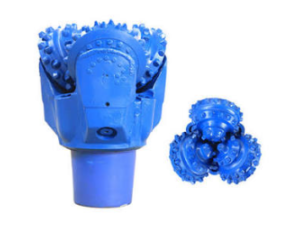
Sandvik is a world-renowned manufacturer of specialized drilling tools and advanced metallurgy. For water well applications requiring exceptional depth penetration in highly abrasive or variable crystalline rock, the Sandvik RR221 and RR321 rotary strike bits are industry benchmarks.
The Sandvik RR221 is a standard tri-cone bit engineered specifically for highly demanding utility and water applications. It features a robust, non-sealed or sealed bearing arrangement depending on whether air or mud is used as the drilling fluid. In deep formations where water wells must pass through thick granite or basalt sequences to reach deep fractured aquifers, the RR221 can operate efficiently at depths down to 3,500 feet. Sandvik’s proprietary carbide grades, developed in their advanced metallurgical laboratories, provide unparalleled resistance to abrasive wear, meaning the bit can stay on the bottom of the hole longer, directly extending the effective maximum depth achievable on a single run.
For many standard water wells drilled into solid rock, contractors prefer down-the-hole air hammer systems over traditional rotary mud systems. Rockmore International is a premier manufacturer of these specialized bits. A critical model used globally for deep water exploration is the Rockmore ROK Series, specifically the ROK 60 and ROK 80 down-the-hole hammers and matching high-grade button bits.
Unlike rotary bits that crush or shear via pure torque, the Rockmore ROK bits are continuously impacted by an internal air-driven piston while rotating slowly. A standard 6-inch or 8-inch Rockmore button bit mounted on a ROK hammer can easily achieve depths of 1,500 to 2,500 feet, provided the surface air compressors have sufficient pressure capacity to blow the heavy water and rock dust out of the deep borehole. The solid, un-jointed steel body of a down-the-hole bit completely eliminates the risk of bearing failure, making it an exceptionally reliable choice for hitting deep fractured rock aquifers.
To provide a clear, scannable reference of how these various standard brands and models compare regarding their recommended optimal geological application, their maximum realistic depth thresholds, and their primary structural cutting mechanisms, the following overview simplifies the selection parameters for deep water well design.
| Brand and Model Line | Primary Cutting Mechanism | Optimal Geology Type | Maximum Standard Depth Capacity |
| Baker Hughes GT-Series | Tungsten Carbide Inserts | Interbedded Limestone and Sandstone | 3,000 to 4,500 Feet |
| Epiroc Secoroc Series | Premium Carbide Rolling Cones | Hard Hard Limestone, Dolomite, Shales | 2,500 to 4,000 Feet |
| Sandvik RR221 / RR321 | Advanced Metallurgy Tri-Cone | Highly Abrasive Granite, Quartzite, Basalt | 3,000 to 3,800 Feet |
| Rockmore ROK 60 / 80 | Percussive DTH Button Face | Solid Fractured Crystalline Bedrock | 1,500 to 2,500 Feet |
| Standard Steel-Tooth Tri-Cone | Milled Steel Teeth | Soft Alluvial Sands, Clays, Mild Shales | 500 to 1,200 Feet |
While the advanced metallurgy of models like the Sandvik RR221 or Baker Hughes GT-Series theoretically allows them to cut through rock at depths far exceeding 4,000 feet, practical field operations introduce severe real-world constraints that often limit a standard water well bit long before its physical teeth wear away. Chief among these practical issues is the structural capacity of the water well drilling rig itself. A standard water well rig possesses a finite hook-load capacity, which is the total weight the rig’s derrick and hydraulic winches can safely lift. As the drill string grows longer, its cumulative weight can approach tens of thousands of pounds. If a standard rig attempts to drill too deep, it may lack the structural power to lift the drill string out of the hole, risking a catastrophic structural collapse of the mast or snapping the drill pipe in two due to extreme tensile stress.
Furthermore, borehole stability becomes highly volatile at extreme depths. Unconsolidated upper layers of soil, sand, or gravel can easily slough off and collapse into the deeper sections of the open borehole if the drilling fluid properties are not meticulously managed. When a collapse occurs, it can completely bury the drill bit under hundreds of feet of debris, causing the bit to become permanently stuck. Additionally, water well diameters are naturally large to accommodate subsequent submersible pumps, starting at 10 to 12 inches at the surface and shifting down to 6 or 8 inches deep down. Drilling such a large diameter hole requires immense torque and massive mud pump volumes. Because of these cumulative logistical and hydraulic limitations, the true, practical maximum depth for an ordinary, standard water well drilling bit operating on a standard utility or water well rig typically tops out around 2,500 to 3,500 feet, even though the high-end bits themselves are metallurgically capable of handling deeper runs under ideal conditions.
To successfully push a standard water well drill bit to its maximum depth capacity, a drilling crew must execute flawless field protocols. The first critical rule involves managing the Weight on Bit and the Rotational Speed, measured in Revolutions Per Minute. It is incredibly tempting for an inexperienced driller to apply excessive downward pressure to force a bit through a stubborn, hard rock layer. However, excessive weight generates immense friction, accelerating the breakdown of internal bearing seals on roller cone bits and causing thermal cracking across the face of fixed cutter bits. Drillers must consult the specific manufacturer’s cut-sheets to pair the exact rock hardness with the correct weight-to-RPM ratio, ensuring a balanced cut that preserves the structural integrity of the bit inserts.
Maintaining pristine drilling fluid parameters is equally vital. The weight, viscosity, and pH of the drilling mud must be tested continuously at the surface. If the mud becomes too thick from accumulated rock dust and clay particles, it creates excessive drag on the rotating drill string, forcing the top-drive motor to work harder and creating a high-pressure environment at the bottom of the hole that can stall out bit performance. Conversely, if the mud is too thin, it cannot successfully lift the heavy rock chips to the surface, leaving them to grind endlessly underneath the bit face. This leads to severe, premature abrasive wear on the body of the bit, a condition known as matrix erosion. By running professional mud cleaners, shale shakers, and desanders at the surface, the drilling team ensures that only clean, properly conditioned fluid is pumped back down to the bit, providing the pristine environment necessary to safely guide the drilling assembly down to its absolute deepest target horizons.

