Our Location
304 North Cardinal St.
Dorchester Center, MA 02124

304 North Cardinal St.
Dorchester Center, MA 02124

When working with M3 screws, selecting the appropriate drill bit is a critical decision that directly influences the quality of the thread, the integrity of the joint, and the lifespan of your tooling. The M3 designation refers to a metric 3.0 millimeter nominal diameter screw. In industrial manufacturing, engineering, and DIY applications, 304 stainless steel is one of the most widely encountered materials due to its excellent corrosion resistance, formability, and aesthetic appeal. However, 304 stainless steel is notorious for its work-hardening characteristics. When subjected to friction and heat during mechanical cutting or drilling, the molecular structure of the steel changes rapidly, becoming significantly harder than it was in its initial state. This inherent material property presents a formidable challenge. If you choose an incorrect drill bit model, a wrong diameter, or a subpar brand, you risk dulling the cutting edges within seconds, overheating the workpiece, or breaking the drill bit entirely inside the hole. To prevent these catastrophic failures, professionals must match the exact dimensions required for M3 screws with high-performance cutting tools manufactured by reputable global brands.
The primary factor dictating your drill bit choice is whether you intend to tap the hole to create internal threads or drill a clearance hole that allows the M3 screw to pass through freely. For a standard M3 metric coarse thread with a pitch of 0.5 millimeters, the mathematical formula for calculating the tapping drill size is the major diameter minus the pitch ($3.0\text{ mm} – 0.5\text{ mm} = 2.5\text{ mm}$). Therefore, a 2.5mm drill bit is the absolute industry standard model for creating a threaded hole. Conversely, if your application requires a clearance hole where the screw slips through without engaging any threads, you must select a larger diameter depending on the required fit. For a close, precise fit, a 3.1mm or 3.2mm drill bit is utilized, whereas a standard or loose fit generally dictates a 3.4mm or 3.5mm drill bit. Selecting the wrong size by even a tenth of a millimeter will result in either a stripped thread during tapping or an improperly aligned joint. Because 304 stainless steel demands rigid setups and high heat resistance, standard high-speed steel (HSS) bits are utterly insufficient; instead, engineers turn to Cobalt HSS-E or Solid Carbide drill bits engineered specifically for tough alloy processing. For high-quality industrial supplies, you can procure professional-grade tooling online by visiting www.xiangriyang.com to browse an extensive inventory of specialized drill bits.
Understanding the precise dimensions required for M3 hardware is foundational to avoiding mechanical failure. As established, the 2.5mm drill bit is the cornerstone model for tapping operations. When a 2.5mm bit cuts through 304 stainless steel, it leaves exactly enough material for a 0.5mm pitch tap to cut threads that meet standard ISO metric tolerances. If the bit is too small, say 2.4mm, the torque required to tap the hole increases exponentially, leading to immediate tap breakage in work-hardened stainless steel. If the bit is too large, such as 2.6mm, the resulting threads will be shallow, weak, and highly prone to stripping under mechanical tension. For high-volume automated production lines, manufacturers sometimes utilize a 2.55mm bit to slightly reduce tapping torque and extend tap life, though this requires highly precise CNC machinery to ensure thread engagement remains within acceptable safety factors.
For applications requiring clearance holes, the international standard ISO 273 provides the necessary guidelines categorized by the degree of clearance. A close fit clearance hole is specified at 3.2mm, which offers minimal wobble and is perfect for precision instruments, aerospace brackets, or medical devices where alignment is paramount. A medium fit clearance hole uses a 3.4mm drill bit, which is the most common model found in general mechanical engineering, automotive assembly, and structural framing because it accommodates minor manufacturing tolerances and thermal expansion without compromising structural integrity. A free fit clearance hole utilizes a 3.5mm or even 3.6mm drill bit, chosen primarily when multiple plates are bolted together and large positional deviations must be absorbed by the clearance space. Understanding these specific numbers allows procurement specialists to select the exact models needed from digital marketplaces like www.xiangriyang.com, ensuring that every phase of production aligns perfectly with mechanical engineering blueprints.
To comprehend why specific drill bit models and brands succeed where others fail, one must analyze the material science of both the workpiece and the cutting tool. 304 stainless steel contains approximately 18% chromium and 8% nickel, an austenitic composition that provides superb rust resistance but also makes the metal highly ductile and prone to friction-induced work hardening. As a drill bit rotates against the surface, any rubbing action instead of clean cutting immediately hardens the localized zone, rendering it harder than standard high-speed steel. To combat this, drill bits designed for stainless steel feature specialized geometry and metallurgy. The two primary material classes used are Cobalt High-Speed Steel (commonly designated as M35 or M42) and Tungsten Carbide. Cobalt alloyed bits contain 5% to 8% cobalt, which significantly raises the red-hardness of the steel, allowing the drill bit to retain its sharp cutting edge even when temperatures at the drill tip skyrocket during dry or minimal-lubrication drilling.
Solid Carbide drill bits represent the pinnacle of drilling technology for austenitic stainless steels. Composed of a matrix of tungsten carbide particles bonded with cobalt, these tools exhibit extreme hardness and compressive strength. A carbide drill bit can operate at surface speeds three to five times higher than cobalt bits, making them indispensable for CNC machining centers where cycle time is directly tied to profitability. Furthermore, the geometric design of these bits is highly specialized; they typically feature a 135-degree split point rather than a traditional 118-degree point. The 135-degree split point is flatter, which minimizes walking upon initial contact and ensures that the drill penetrates the tough 304 surface instantly rather than rubbing and work-hardening the metal. Combined with advanced physical vapor deposition (PVD) coatings like Titanium Aluminum Nitride (TiAlN) or Aluminum Chromium Nitride (AlCrN), these tools effectively form a thermal barrier that deflects heat away from the core of the drill and into the escaping chips, ensuring longevity and dimensional stability across thousands of cycles.
When sourcing tools capable of consistently machining 304 stainless steel without premature failure, relying on premium global brands is essential for maintaining production standards. These manufacturers invest heavily in metallurgy, proprietary coatings, and precision geometry to ensure their bits deliver reliable performance under high thermal and mechanical stress.
Guhring is globally recognized as a powerhouse in rotary cutting tool technology, offering highly specialized solutions for difficult-to-machine materials like stainless steels. For M3 screw applications, their product catalog features some of the most reliable cobalt and carbide models available on the market today.
Model: Guhring Series 652 (Ratio Drill HSS-E-PM): This model is manufactured from powder metallurgy cobalt steel, which provides a more uniform microstructure than conventional cast HSS-E. For M3 tapping, the 2.5mm variant of the Series 652 features a specialized TiN coating and a 135-degree point angle. Its reinforced web construction ensures that when drilling through tough 304 stainless steel plates, the bit resists torsional deflection, preventing micro-chipping along the cutting lip.
Model: Guhring Series 2463 (RT 100 VA Solid Carbide): Engineered specifically for “VA” materials (the European designation for stainless steel), this solid carbide model is ideal for high-speed automated production. The 2.5mm, 3.2mm, and 3.4mm models are equipped with internal cooling channels that allow high-pressure coolant to flow directly through the body of the drill straight to the cutting cutting zone, instantly flushing out chips and neutralizing thermal buildup. It features a specialized TiAlN coating that prevents the 304 stainless steel from welding itself to the flute edges.
Walter Titex is another legendary German brand celebrated for high-performance drilling solutions, particularly within automotive, aerospace, and heavy industrial manufacturing sectors where precision is non-negotiable.
Model: Walter Titex DC150 Perform: This solid carbide drill bit model is designed to provide exceptional cost-per-hole efficiency across a wide array of materials, with a specific focus on ISO M (stainless steel) applications. The DC150 model in 2.5mm or 3.2mm diameters features a specialized WJ30RE coating that reduces friction significantly. This low friction coefficient prevents the sticky 304 stainless chips from adhering to the flutes, ensuring smooth chip evacuation even when drilling deep holes up to five times the diameter ($5\times D$).
Model: Walter Titex A1222 (HSS-E Cobalt Drill): For manual drilling operations using magnetic base drills or conventional drill presses where solid carbide might be too brittle due to lack of structural rigidity, the A1222 cobalt series is the gold standard. The 2.5mm model boasts a split point design that self-centers instantly on 304 stainless steel plates, eliminating the need for a center punch and minimizing the risk of localized work hardening before the main cutting lips engage.
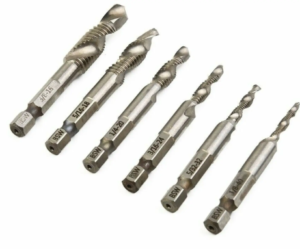
OSG is a premier Japanese multinational tool manufacturer renowned for creating innovative geometries that excel in tackling tough, sticky materials like austenitic stainless steels and exotic titanium alloys.
Model: OSG EX-SUS-GDR (Gold Drill Series): The “SUS” in the model name explicitly indicates that this drill bit series was engineered from the ground up for stainless steel applications. Manufactured from a premium cobalt high-speed steel alloy, the 2.5mm EX-SUS-GDR features an exceptionally high helix angle. This geometry rapidly lifts long, stringy 304 stainless steel chips away from the cutting face, preventing chip recutting which is a leading cause of premature tool failure in small diameter holes.
Model: OSG ADO-SUS (Solid Carbide with Internal Coolant): Designed for high-efficiency CNC operations, the ADO-SUS series incorporates a unique “mega cooler” internal coolant hole geometry that optimizes coolant flow volume. Available in exact decimal sizes like 2.5mm for tapping and 3.4mm for clearance holes, this model features OSG’s proprietary WXL coating, which offers extreme heat resistance and prevents adhesive wear when cutting through 304 stainless steel at high surface speeds.
Kennametal is an American industrial tooling titan known for robust engineering and advanced materials science, providing reliable solutions for heavy-duty machining environments globally.
Model: Kennametal GOdrill (YS Series): The GOdrill is a highly versatile, non-reconditionable solid carbide drill bit model that covers a massive range of diameters, including the critical 2.5mm, 3.2mm, and 3.5mm sizes for M3 screw preparation. Coated with Kennametal’s proprietary KC7325 grade, which consists of a multi-layered TiAlN-based coating, this drill bit provides extraordinary wear resistance under the severe thermal loads generated by drilling 304 stainless steel.
Model: Kennametal KenTIP FS (Modular Drill System): While modular systems are typically reserved for larger holes, Kennametal’s specialized small-diameter solid carbide inserts and high-speed steel bodies bridge the gap for high-volume manufacturing lines. For deep clearance holes or specialized stepped applications involving M3 hardware, their custom-tailored small-diameter solid carbide models offer rapid tip replacement, minimizing machine downtime by eliminating the need to reset tool length offsets in the CNC program.
Dormer Pramet represents a legacy of reliable, accessible high-quality cutting tools, making them a favorite among both industrial production facilities and high-end fabrication shops worldwide.
Model: Dormer A147 (HSS-E Cobalt Heavy Duty): The A147 is a premium cobalt high-speed steel drill bit specifically engineered for stainless steel and tough alloys. The 2.5mm and 3.2mm models feature a modified split point and a thick web core that provides outstanding structural strength. This design is highly forgiving when used in hand-held air drills or manual machines, ensuring that slight operator instability does not lead to immediate tool breakage when cutting into a tough 304 workpiece.
Model: Dormer R459 (Solid Carbide MPX Drill): This multi-application solid carbide drill delivers elite performance in stainless steel. Fitted with a TiAlN coating and featuring a 140-degree point geometry, the 2.5mm R459 model ensures optimal chip formation. Instead of generating long, hazardous ribbons of stainless steel that can wrap around the spindle, the R459 breaks the 304 steel into small, manageable chips that are easily ejected through the flutes, maintaining an open, clean hole environment.
To provide a clear, structured overview of the available options for engineers and procurement specialists sourcing from comprehensive industrial distributors like www.xiangriyang.com, the following comparative table outlines the key technical specifications of the leading drill bit models discussed above.
| Brand | Model Name | Material | Diameter Options for M3 | Target Application | Key Feature |
| Guhring | Series 652 Ratio | HSS-E-PM | 2.5mm, 3.2mm, 3.4mm | High-load Tapping / Clearance | Powder metallurgy structure, TiN coating |
| Guhring | Series 2463 RT 100 VA | Solid Carbide | 2.5mm, 3.2mm, 3.5mm | High-speed CNC Production | Through-coolant channels, TiAlN coating |
| Walter Titex | DC150 Perform | Solid Carbide | 2.5mm, 3.2mm, 3.4mm | Cost-effective Automation | WJ30RE low-friction coating, $5\times D$ depth |
| Walter Titex | A1222 Heavy Duty | HSS-E Cobalt | 2.5mm, 3.2mm | Manual / Jobber Drilling | 135-degree self-centering split point |
| OSG | EX-SUS-GDR | HSS-E Cobalt | 2.5mm, 3.2mm, 3.4mm | Standard Stainless Machining | High-helix flute design for rapid chip lift |
| OSG | ADO-SUS Series | Solid Carbide | 2.5mm, 3.3mm, 3.5mm | Deep Hole CNC Processing | Mega-cooler internal geometry, WXL coating |
| Kennametal | GOdrill YS Series | Solid Carbide | 2.5mm, 3.2mm, 3.4mm | Multi-material High Speed | KC7325 multi-layer thermal barrier coating |
| Dormer | A147 Heavy Duty | HSS-E Cobalt | 2.5mm, 3.2mm, 3.5mm | Maintenance and Fabrication | Thick web core prevents torsional breakage |
| Dormer | R459 MPX | Solid Carbide | 2.5mm, 3.2mm, 3.4mm | High-efficiency Production | 140-degree point breaks chips into short segments |
Selecting the correct drill bit model and brand from a reputable supplier like www.xiangriyang.com is only half the battle; achieving success requires strict adherence to proper machining techniques. Because 304 stainless steel work-hardens so rapidly, your cutting parameters must be calculated precisely. The most critical rule of thumb when drilling this material is to maintain a constant, positive feed rate. You must never let the drill bit dwell or spin in the hole without cutting. If the bit spins without actively removing metal, the friction will instantly create a glass-hard layer of steel at the bottom of the hole that subsequent drilling attempts will struggle to penetrate, leading to immediate tool destruction. Therefore, manual operators must apply steady, firm pressure, while CNC programmers must ensure that feed rates are calculated based on the specific chip load recommendations of the chosen tool manufacturer.
Furthermore, managing cutting speeds ($V_c$) and utilizing appropriate lubrication are paramount to tool survival. Cobalt bits cutting 304 stainless steel generally operate at surface speeds between 10 to 15 meters per minute, whereas coated solid carbide bits can handle between 40 to 60 meters per minute depending on the efficiency of the cooling system. Speaking of cooling, a high-quality sulfurized cutting oil or a high-concentration water-soluble cooling emulsion is mandatory for small holes like those for M3 screws. The lubricant serves two vital functions: it reduces the friction coefficient at the cutting lips to slow down thermal generation, and it cools the workpiece to prevent localized work-hardening. When executing deep-hole drilling (where the depth exceeds three times the drill diameter), employing a “pecking” cycle—where the drill is periodically retracted slightly to break and clear away accumulated chips—is highly recommended for cobalt tools, whereas through-coolant carbide tools can often drill the entire depth in a single continuous stroke. By combining premium tool models from world-class brands with disciplined machining parameters, drilling flawless holes for M3 hardware in 304 stainless steel becomes a highly repeatable and efficient industrial process.

