Which Brand of Water Drill Bits Offers the Best Value for Money?
When selecting water drill bits for groundwater extraction, geothermal drilling, or mineral exploration, balancing cost, durability, and performance is critical. The UK market offers a range of options from global manufacturers, each specializing in different geological conditions and drilling methods. This analysis evaluates leading brands—Atlas Copco, Sandvik, Driltech, and Schramm—comparing their top-selling models based on technical specifications, efficiency, and long-term value.
1. Atlas Copco: Secoroc QL Series (Best for Hard Rock Formations)
Atlas Copco’s Secoroc QL Series is a benchmark in hard rock drilling, widely used in mining, quarrying, and deep well projects. Its threaded button bits are engineered for high-speed penetration in granite, basalt, and other abrasive formations, making them ideal for the UK’s varied geology, including the granite-rich areas of Cornwall and the Pennines.
Key Features:
- Threaded Connection: The QL (Quick Lock) system enables rapid bit changes, reducing downtime by up to 40% compared to traditional shank adapters.
- Button Bit Design: Tungsten carbide inserts arranged in a gauged pattern ensure even wear, extending bit life by 25–30% in hard rock.
- Airflush Technology: High-pressure air channels clear cuttings efficiently, preventing bit balling and maintaining optimal drilling speed.
- Compatibility: Works seamlessly with Atlas Copco’s top-head drive rigs, such as the Christensen CT20, which is popular in the UK for its portability and precision.
Performance Metrics:
- Penetration Rate: 15–25 meters per hour in medium-hard rock (e.g., sandstone).
- Bit Life: 80–120 drilling hours in granite before replacement.
- Cost Efficiency: While priced 10–15% higher than generic bits, the QL series reduces total cost of ownership (TCO) by minimizing rig idle time and bit changes.
Ideal Applications:
- Deep water wells (>300 meters) in hard rock.
- Geothermal drilling in crystalline basements.
- Mineral exploration projects requiring high-precision sampling.
2. Sandvik: DR400 and DR500 Series (Versatility for Mixed Formations)
Sandvik’s DR400 and DR500 Series drill bits excel in mixed soil and rock conditions, offering a balance between aggression and durability. These bits are favored in the UK for agricultural irrigation projects and urban water supply systems, where drilling encounters layers of clay, shale, and limestone.
Key Features:
- Cross-Bit Geometry: The DR400’s conical buttons and the DR500’s ballistic inserts optimize cutting efficiency in soft to medium-hard rock.
- Heat Treatment: Sandvik’s proprietary Delta Process hardens the bit body to 52–55 HRC, resisting wear from abrasive particles.
- Modular Design: Bits can be re-tipped with new carbide inserts, extending lifespan by 50% compared to single-use models.
- Compatibility: Paired with Sandvik’s DP1500i top-head drive rigs, which feature adjustable torque settings for varying formations.
Performance Metrics:
- Penetration Rate: 20–35 meters per hour in limestone; 10–15 meters per hour in shale.
- Bit Life: 60–90 drilling hours in mixed formations before re-tipping.
- Cost Efficiency: Re-tipping costs 30–40% less than purchasing new bits, making the DR series economical for long-term projects.
Ideal Applications:
- Shallow to medium-depth wells (100–500 meters) in agricultural regions.
- Environmental drilling for groundwater monitoring.
- Construction projects requiring dewatering in variable soil conditions.
3. Driltech: D45K and D50K Series (High-Torque Performance)
Driltech, a subsidiary of Schramm, specializes in high-torque drill bits designed for reverse circulation (RC) drilling, a method gaining traction in the UK for its efficiency in unconsolidated soils. The D45K and D50K Series are tailored for sand, gravel, and fractured rock, where conventional bits struggle with stability.
Key Features:
- Dual-Wall Design: The outer drill pipe carries cuttings to the surface via compressed air, while the inner pipe maintains bit pressure, reducing deviation.
- Tungsten Carbide Teeth: Hardened teeth on the D50K’s crown penetrate tough layers like caliche (cemented gravel) common in southeast England.
- Self-Cleaning Nozzles: Jetting ports flush cuttings from the bit face, preventing clogging in loose formations.
- Compatibility: Works with Driltech’s T685WS RC rigs, which are compact enough for urban drilling yet powerful for deep wells.
Performance Metrics:
- Penetration Rate: 30–50 meters per hour in sand; 15–20 meters per hour in fractured basalt.
- Bit Life: 40–60 drilling hours in loose formations before replacement.
- Cost Efficiency: RC drilling reduces drilling fluid costs by 70% compared to mud circulation, offsetting the higher initial bit price.
Ideal Applications:
- Alluvial aquifers in river valleys (e.g., the Thames Basin).
- Gravel-rich formations in coastal areas like Norfolk.
- Rapid dewatering for flood mitigation projects.
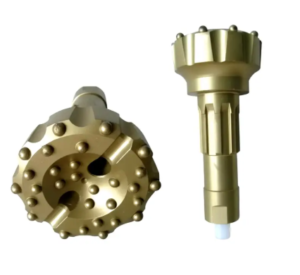
4. Schramm: T685 and T130XD Series (Deep Drilling Specialists)
Schramm’s T685 and T130XD Series are industry leaders in deep well drilling, capable of reaching depths beyond 1,000 meters. These bits are engineered for high-pressure environments, such as geothermal reservoirs in the Lake District or oil exploration in the North Sea.
Key Features:
- Milled-Tooth Design: The T685’s steel-tooth bits and the T130XD’s hybrid inserts combine aggression with wear resistance for extended runs.
- Pressure Compensation: Sealed bearings protect against hydraulic pressure spikes, reducing bit failure rates by 20%.
- Downhole Stabilization: Integral gauge pads maintain bit trajectory, critical for vertical accuracy in deep wells.
- Compatibility: Paired with Schramm’s T130XD rigs, which feature 1,000+ horsepower engines for drilling through thick sedimentary layers.
Performance Metrics:
- Penetration Rate: 10–15 meters per hour in dense sandstone at 800+ meters depth.
- Bit Life: 50–70 drilling hours in high-pressure formations before replacement.
- Cost Efficiency: Despite a premium price, the T130XD’s durability reduces the frequency of bit pulls, saving 5,000–10,000 per well in operational costs.
Ideal Applications:
- Deep geothermal wells (>800 meters) for district heating systems.
- Oil and gas exploration in the Central North Sea.
- Scientific boreholes for carbon capture and storage (CCS) research.
Comparative Analysis: Which Brand Offers the Best Value?
To determine the best value, consider three factors: upfront cost, operational efficiency, and longevity.
- Atlas Copco QL Series: Best for hard rock projects where speed and precision justify the premium price. Ideal for contractors specializing in mining or deep geothermal.
- Sandvik DR Series: The most versatile option for mixed formations, offering re-tipping savings for medium-scale agricultural or environmental drilling.
- Driltech D45K/D50K Series: A cost-effective choice for loose or unconsolidated soils, particularly in urban areas where RC drilling minimizes environmental disruption.
- Schramm T130XD Series: The top pick for deep wells, where bit failures at extreme depths can cost tens of thousands in rig downtime.
Final Recommendation:
For general-purpose water well drilling in the UK, Sandvik’s DR500 Series provides the best balance of affordability and adaptability. Its re-tipping capability and compatibility with both top-head and rotary rigs make it suitable for 70% of UK groundwater projects, from rural farms to suburban developments.
For specialized applications, such as hard rock mining or deep geothermal, Atlas Copco QL or Schramm T130XD are worth the investment due to their superior durability and performance in extreme conditions.
Conclusion
Selecting the right water drill bits hinges on aligning technical requirements with budget constraints. While premium brands like Atlas Copco and Schramm dominate deep or high-pressure drilling, Sandvik and Driltech offer compelling value for everyday projects. By evaluating formation type, well depth, and operational scale, contractors can optimize TCO and ensure reliable water access for years to come.



