Our Location
304 North Cardinal St.
Dorchester Center, MA 02124

304 North Cardinal St.
Dorchester Center, MA 02124

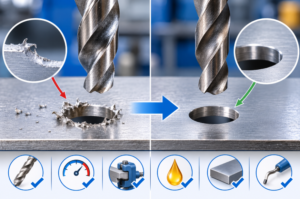
Burr formation is one of the most common problems when drilling metal sheets. Whether you are drilling stainless steel, aluminum, mild steel, copper, or other sheet metal materials, burrs can appear around the entrance and exit of the drilled hole. These unwanted raised edges not only affect the appearance of the finished product but can also create safety hazards, interfere with assembly, and increase additional finishing costs.
Reducing burrs during drilling is essential for manufacturers who require clean holes, accurate dimensions, smooth edges, and consistent production quality. By selecting the right drill bit, optimizing cutting parameters, securing the workpiece, and applying proper drilling techniques, you can significantly minimize burr formation.
This guide explains why burrs occur when drilling metal sheets and provides practical methods to achieve cleaner drilling results.
Before trying to reduce burrs, it is important to understand how they develop.
During drilling, the cutting edges of a drill bit remove material from the metal sheet. As the drill approaches the bottom surface, the remaining metal becomes thinner and weaker. Instead of being completely removed by the cutting edges, some of the material may deform, bend, and stretch outward.
This creates a raised metal edge known as an exit burr.
Several factors influence burr formation:
Understanding these factors helps operators identify the correct improvements for their drilling operations.
Drill bit selection is one of the most important factors affecting hole quality and burr formation.
Different metal materials require different cutting geometries, hardness levels, and drilling characteristics.
High-speed steel (HSS) drill bits are widely used for general-purpose metal drilling. They offer good toughness and are suitable for mild steel, aluminum, copper, and many other common materials.
For sheet metal applications, a sharp HSS drill bit with suitable point geometry can produce clean holes while reducing excessive material deformation.
Cobalt drill bits, such as M35 and M42, provide improved heat resistance and hardness compared with conventional HSS tools.
They are particularly useful for drilling stainless steel and other demanding metal materials.
Their ability to maintain cutting performance under elevated temperatures makes them suitable for repeated industrial drilling operations.
Carbide drill bits offer excellent hardness and wear resistance. They are commonly used in high-speed machining and applications requiring dimensional consistency.
However, carbide is more brittle than HSS, so proper machine rigidity and workpiece stability are important.
Step drill bits are especially useful for drilling thin metal sheets. Their stepped cutting geometry allows operators to create different hole diameters using a single tool.
They can help produce relatively clean holes in thin materials, provided the correct cutting speed and drilling pressure are used.
Selecting the correct drill bit according to material thickness, hardness, and hole diameter is essential for minimizing burrs.
A sharp drill bit cuts through metal more efficiently and produces less unwanted deformation.
When cutting edges become dull, the drill bit starts rubbing and pushing material instead of removing it effectively. This increases friction, cutting temperature, and the force required to penetrate the sheet.
These conditions often result in larger burrs.
To maintain good drilling quality:
For high-volume manufacturing, establishing a regular drill bit inspection and replacement schedule can help maintain consistent hole quality.
Cutting speed and feed rate directly affect drilling performance.
If the RPM is too high, excessive heat may develop, particularly when drilling stainless steel. If the feed rate is too low, the drill bit may rub against the material instead of cutting efficiently.
On the other hand, excessive feed pressure can cause the sheet metal to deform and produce larger exit burrs.
The best cutting parameters depend on several factors:
For thin sheet metal, maintain a stable feed rate and avoid applying excessive downward pressure.
It is also important to avoid sudden changes in feed pressure when the drill bit approaches the exit surface.
Always follow the drill bit manufacturer’s recommended cutting parameters and adjust them according to actual machining conditions.
Workpiece stability is another important factor in burr reduction.
Thin metal sheets are more likely to vibrate, bend, or lift during drilling. When the material is not adequately supported, the drill bit may pull the sheet upward as it breaks through the bottom surface.
This can produce irregular holes, larger burrs, and inconsistent dimensions.
Consider the following methods:
Use clamps: Secure the metal sheet firmly to prevent movement during drilling.
Install a backing plate: Place a sacrificial backing material underneath the sheet to support the exit surface.
Use a drill press: A drill press provides better control over drilling direction and feed pressure than handheld drilling in many applications.
Reduce vibration: Ensure the worktable, fixture, and workpiece are stable before starting the drilling process.
A properly supported sheet allows the cutting edges to work more consistently and reduces unwanted material deformation.
Using a backing plate is one of the most practical methods for reducing burr formation when drilling thin metal sheets.
A backing plate supports the material directly beneath the drilling area. It helps prevent the sheet from bending or deforming as the drill bit exits the material.
Suitable backing materials may include:
The backing plate should be securely positioned against the underside of the workpiece.
This technique is particularly beneficial when drilling thin stainless steel, aluminum, and other sheet metal materials.
However, the backing material must be compatible with the drilling operation and should not introduce additional contamination or damage.
Cutting lubrication helps reduce friction and heat during drilling.
Excessive friction can accelerate drill bit wear and cause metal material to stick to the cutting edges. These problems can negatively affect cutting quality and increase burr formation.
Depending on the metal material, suitable cutting fluids may include:
When drilling stainless steel, appropriate lubrication can help reduce heat buildup and improve tool life.
When drilling aluminum, select a lubricant that helps prevent material from adhering to the cutting edges.
Use the lubricant recommended for the workpiece material and drilling tool.
The moment when the drill bit exits the bottom of a metal sheet is especially important.
At this stage, the remaining material is thin and can easily deform under excessive cutting pressure.
To reduce exit burrs:
The goal is to remove material through controlled cutting rather than pushing and deforming the remaining metal.
For production operations, machines with controlled feed systems can improve consistency during breakthrough.
Step drill bits are particularly effective for applications involving different hole diameters in thin metal sheets.
Unlike conventional twist drill bits, step drill bits feature multiple cutting diameters arranged along a stepped profile.
<PRIVATE_PERSON>For example, a single step drill bit may include several diameter sections, allowing operators to drill multiple hole sizes without frequently changing tools.</PRIVATE_PERSON>
Advantages include:
However, correct operation is essential. Excessive feed pressure or unsuitable cutting speed can still produce burrs.
Choose a step drill bit with suitable diameter ranges, cutting geometry, and material compatibility.
Even with optimized drilling conditions, some burrs may remain.
For applications requiring smooth edges and precise assembly, secondary deburring may be necessary.
Common deburring methods include:
Manual Deburring Tools
Handheld deburring tools can remove small burrs around drilled holes. They are suitable for low-volume production and maintenance work.
Countersink Tools
Countersink bits can remove sharp edges and create a small chamfer around the hole.
Rotary Deburring Tools
Rotary tools equipped with suitable abrasive or cutting attachments can process multiple holes efficiently.
Mechanical Deburring Machines
For large-scale manufacturing, automated deburring equipment can improve consistency and reduce manual labor.
The appropriate method depends on the required edge quality, production volume, and material thickness.
Different metals behave differently during drilling, so the same drilling parameters should not be used for every material.
| Metal Material | Common Drilling Challenges | Recommended Considerations |
|---|---|---|
| Aluminum | Material adhesion and edge deformation | Sharp drill bits and suitable lubrication |
| Stainless Steel | Work hardening and heat buildup | Cobalt or suitable carbide tools, controlled feed |
| Mild Steel | Burr formation and tool wear | Sharp HSS or cobalt drill bits |
| Copper | Material deformation and sticking | Sharp cutting edges and stable support |
| Brass | Edge deformation and grabbing | Appropriate drill geometry and controlled feed |
For thin materials, workpiece support and breakthrough control are particularly important regardless of the metal type.
Avoiding common drilling mistakes can significantly improve finished hole quality.
Using the Wrong Drill Bit
A drill bit designed for wood or general-purpose applications may not provide the correct cutting performance for metal sheets.
Applying Too Much Pressure
Excessive downward force can deform thin sheet metal and increase exit burrs.
Ignoring Drill Bit Wear
Dull cutting edges produce more friction and require greater drilling force.
Drilling Without Proper Support
Unsupported sheets can vibrate or bend, resulting in irregular holes.
Using Incorrect RPM
Unsuitable rotational speed can increase heat, reduce cutting efficiency, and accelerate tool wear.
Ignoring Post-Drilling Inspection
Small burrs can affect assembly and product safety. Inspect drilled holes before moving to the next manufacturing process.
For manufacturers producing large quantities of metal components, burr reduction should be treated as part of the entire drilling process rather than an isolated finishing step.
A practical improvement strategy includes:
Combining these measures can reduce secondary finishing operations, improve production efficiency, extend tool life, and maintain consistent product quality.
Burrs generally develop because the remaining material deforms as the drill bit exits the bottom surface. Excessive feed pressure, dull cutting edges, poor workpiece support, and unsuitable cutting parameters can make the problem worse.
Sharp HSS, cobalt, carbide, and step drill bits can all produce good results when selected according to the material and application. For thin sheet metal, a properly designed step drill bit is often a practical choice.
Not necessarily. The ideal drilling speed depends on the material, drill bit diameter, tool geometry, and machine conditions. An excessively slow speed may cause rubbing, while an excessively high speed may generate too much heat.
A backing plate can significantly reduce exit burr formation by supporting the sheet during breakthrough. However, it does not guarantee completely burr-free holes. Tool sharpness and drilling parameters remain important.
Use sharp cobalt or suitable carbide drill bits, maintain a stable feed rate, apply appropriate cutting lubricant, secure the workpiece, and avoid excessive heat and pressure.
Yes. Step drill bits are commonly used for drilling aluminum sheets and panels. Select a sharp tool with suitable cutting geometry and use appropriate cutting speed and lubrication.
Reducing burrs when drilling metal sheets requires the right combination of drill bit selection, cutting parameters, workpiece support, lubrication, and drilling technique.
For the best results, start with a sharp drill bit designed for your specific material. Secure the sheet properly, maintain suitable RPM and feed pressure, use a backing plate when necessary, and control the breakthrough process carefully.
For industrial applications, choosing high-quality drilling tools and maintaining consistent machining conditions can significantly improve hole quality while reducing additional deburring work.
Choosing the right drill bit is essential for achieving accurate holes, smooth cutting edges, and reliable drilling performance.
Xiangriyang (www.xiangriyang.com) provides information and product resources related to industrial drilling tools and cutting solutions. Whether you are looking for metal drill bits, HSS drill bits, cobalt drill bits, carbide drill bits, or specialized drilling tools, Xiangriyang can help you explore suitable options for different materials and machining applications.
When selecting a drill bit, consider its material, diameter, cutting geometry, application range, and compatibility with your drilling equipment.
Visit www.xiangriyang.com to explore more industrial drill bit products, technical information, and drilling solutions for professional manufacturing and metalworking applications.

